
Patients comparing Endolift vs fractional CO₂ laser are often told that both treatments stimulate collagen and tighten skin. That statement is broadly plausible, but it does not tell us whether they are equally effective, whether one is superior, or which anatomical problem each treatment is best suited to address. Dr. Sasi Kiran Attili is a UK-trained dermatologist and board-certified dermatopathologist who assesses complex dermatological and aesthetic-treatment problems, including patients whose symptoms do not fit the expected post-procedure course. The most useful comparison therefore starts with evidence quality and treatment depth rather than marketing terminology.
Understanding Endolift vs Fractional CO₂ Laser
Endolift and fractional CO₂ laser both use thermal energy, but they deliver it in fundamentally different ways.
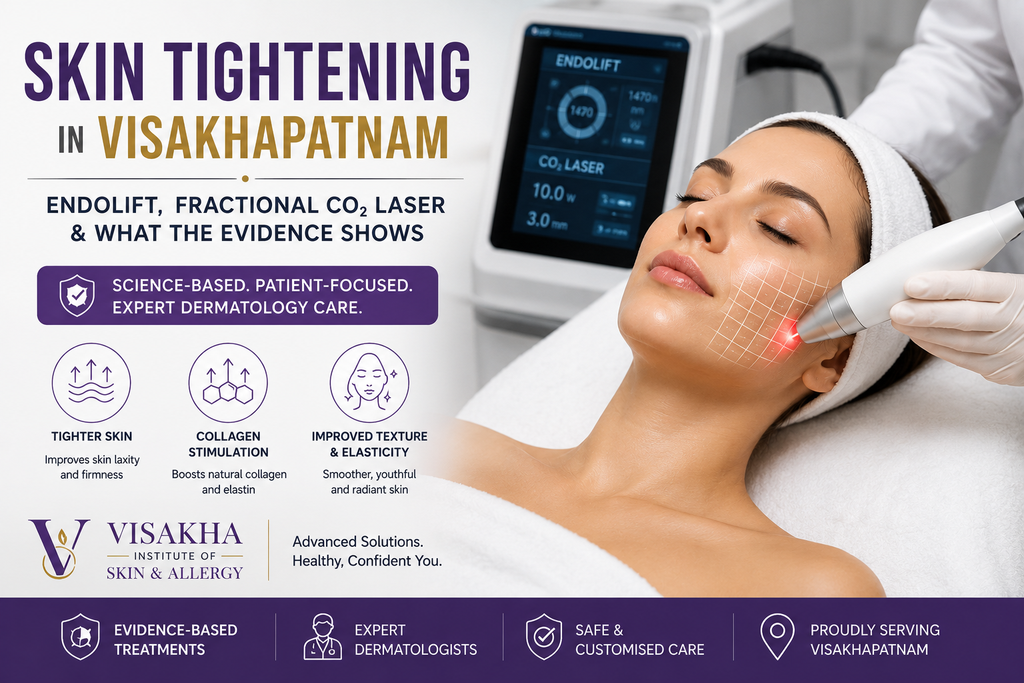
Endolift uses a 1470-nm diode laser transmitted through a fine optical fibre passed beneath the skin. The intention is to heat deep dermal and superficial subcutaneous tissues. Depending on the depth and energy delivered, treatment may influence collagen-rich tissue, fibrous septa and superficial fat.
Fractional CO₂ laser approaches the problem from the skin surface. Fractionated columns of treatment induce controlled tissue injury followed by remodelling. Its published evidence includes objective measurement of skin mechanical properties and controlled human histological evidence of increased collagen.
This distinction matters. Evidence that two procedures both stimulate collagen does not demonstrate that they produce the same clinical result.
Why Standard Treatments Often Fail
Problems arise when “skin tightening” is treated as though it were a single diagnosis.
A patient whose dominant concern is fine wrinkling, photodamage and surface texture does not necessarily require the same treatment plane as someone whose appearance is influenced by lower-face heaviness or superficial subcutaneous tissue. Similarly, a patient with persistent pain or swelling after a procedure should not simply be offered another tightening treatment before the cause has been evaluated.
Treatment can also become unnecessarily confusing when marketing claims are substituted for comparative evidence. A newer device may have a credible mechanism without yet having proved that it performs better than an established alternative.
The Diagnostic Approach
The first step is to establish which problem is actually being treated.
For uncomplicated cosmetic concerns, this means distinguishing wrinkles and texture from true laxity and from deeper lower-face heaviness. Previous procedures are also relevant. A history of hyaluronic-acid filler should be documented because thermal energy can interact with previously injected material and delayed inflammatory filler reactions are recognised.
Persistent tenderness, swelling, pain or nodules after Endolift require a different diagnostic pathway. Possible explanations may include a delayed inflammatory reaction involving existing filler, thermal alteration of filler, infection or a direct procedural complication. The temporal association alone does not prove which mechanism is responsible.
Evidence-Based Treatment Strategies for Endolift vs Fractional CO₂ Laser
Fractional CO₂ for dermal remodelling
Fractional CO₂ has comparatively mature evidence for remodelling of the dermis.
Naouri and colleagues prospectively measured skin mechanical properties using a Cutometer before and after fractional CO₂ treatment. Elasticity improved by 5.9%, with statistically significant improvement in several additional biomechanical parameters.
Human controlled histology provides another useful layer of evidence. In a split-face study involving women treated before blepharoplasty, the fractional CO₂-treated side demonstrated significantly greater type I and type III collagen than the untreated control side.
These findings do not establish that fractional CO₂ is superior for every form of facial laxity. They do show that its effect on dermal collagen is supported by more than subjective photographs.
Endolift and subdermal treatment
Endolift has a credible biological mechanism and early evidence of clinical benefit.
A 96-patient study reported improvement in lower-face laxity with follow-up extending to 18 months. However, the source article notes important methodological limitations, including the lack of a sham or untreated comparison and reliance largely on clinical grading.
Systematic reviews have reached different levels of confidence. A 2024 review was broadly favourable while acknowledging the predominance of lower-level observational research. A more critical 2025 review identified only seven eligible studies and highlighted high risk of bias, inconsistent parameters and insufficient safety data.
A 2025 human histological study demonstrated increased dermal thickness and collagen deposition at moderate treatment energies. At the highest energy tested, collagen fragmentation and less organised elastin were observed, reinforcing the principle that greater thermal exposure is not automatically better.
Is Endolift superior?
Based on the evidence supplied for this article, superiority has not been demonstrated.
There is no head-to-head randomized comparison in the supplied literature showing that Endolift produces greater tightening than fractional CO₂, no comparative human histological study demonstrating greater collagen production and no convincing evidence within the source that its clinical results last longer.
Endolift nevertheless has a plausible anatomical advantage: subdermal delivery allows treatment of superficial fat and fibrous septa that fractional CO₂ does not directly reach. That may prove useful in carefully selected patients with lower-face heaviness or jowling, but anatomical plausibility should not be confused with proven comparative superiority.
Endolift when dermal filler is already present
This remains an important evidence gap.
Hyaluronic-acid filler is not necessarily thermally inert. A 2024 review cited in the source found that energy-based devices can influence HA filler degradation, with the effect depending on device type, energy, depth, filler characteristics and timing.
Delayed inflammatory reactions to HA filler are also recognised and may appear months after injection with swelling, tenderness or nodules.
Most importantly, the supplied literature contains no study specifically assessing Endolift performed through or adjacent to pre-existing HA filler. The responsible conclusion is therefore that the interaction remains insufficiently studied—not that absence of evidence proves absence of risk.
Who Should Seek a Second Opinion or Online Consultation?
A specialist second opinion may be particularly useful when the problem is no longer a straightforward cosmetic-treatment decision.
This includes patients with persistent pain, tenderness, swelling or nodules after Endolift; people who previously had filler in the same anatomical area; treatment-resistant cases; and patients who have received conflicting explanations for unexpected symptoms.
Patients outside India may also seek structured specialist input when they need help understanding an existing diagnosis, treatment history or proposed procedure. People who have been told that “nothing can be done” may benefit from reconsidering whether the correct underlying problem has actually been identified.
An online consultation cannot replace every physical examination or procedure. Its value is often in organising the history, identifying the most plausible diagnostic questions, reviewing existing records and determining what type of in-person assessment or investigation is appropriate next.
Frequently Asked Questions
Is Endolift better than fractional CO₂ laser?
There is no evidence in the supplied literature demonstrating that Endolift is generally superior to fractional CO₂ for skin tightening. The two treatments work at different anatomical depths, and fractional CO₂ currently has the more established objective evidence for dermal collagen remodelling.
Which treatment has better evidence for collagen remodelling?
Fractional CO₂ has stronger established evidence in the material reviewed here. This includes objective measurement of skin mechanical properties and controlled human histology showing increased type I and type III collagen.
Endolift also has histological evidence of collagen effects, but its overall clinical evidence base is smaller and less consistent.
Can Endolift affect old dermal filler?
It is biologically plausible that thermal treatment could interact with existing hyaluronic-acid filler, and energy-based devices have been reported to affect filler degradation. However, the supplied literature contains no direct study specifically examining Endolift through or adjacent to old HA filler.
That means the interaction cannot currently be described as either proven harmful or proven harmless.
What should I do if swelling or pain persists after Endolift?
Persistent pain, tenderness or swelling two months after treatment should not simply be assumed to represent normal recovery. The differential diagnosis may include procedure-related inflammation, infection, an inflammatory filler reaction or an interaction involving previous filler.
The correct next step is clinical assessment rather than attempting to identify the cause from timing alone.
Can skin laxity be treated through an online consultation?
The treatment itself cannot be performed online, but an online consultation can help determine whether the primary problem appears to be dermal texture, laxity, deeper lower-face heaviness or a complication of previous treatment. It can also be useful for reviewing treatment history, photographs and existing medical information before deciding whether an in-person procedure is appropriate.
Complex post-procedure symptoms may still require physical examination or investigations locally.
What does a dermatopathologist look for that a regular dermatologist might miss?
Dermatopathology adds a detailed understanding of inflammatory and structural changes in skin tissue, but not every laser or filler complication requires a biopsy. Its value is greatest when the clinical picture is atypical, persistent or raises questions about an inflammatory process that may eventually require tissue correlation.
For routine aesthetic treatment selection, the clinical history and examination remain fundamental.
Does FDA clearance prove Endolift is a clinically proven non-surgical facelift?
No. Regulatory clearance of a laser platform should not be interpreted as evidence that a specific aesthetic application has been proven superior to other treatments.
Claims about comparative tightening, duration and patient benefit still require appropriate clinical studies.
Should I choose Endolift or fractional CO₂?
That depends on the anatomical target rather than the marketing category of “skin tightening”. Fractional CO₂ has stronger evidence for wrinkles, texture, photodamage and dermal collagen remodelling, while Endolift can deliver energy to deeper subdermal structures.
A treatment should therefore be selected according to what is producing the visible concern and the quality of evidence supporting the proposed benefit.
If you have a complex skin laxity or post-Endolift case, have tried treatments without success, or need a specialist second opinion, Dr. Attili offers structured online consultations. [Book Online Consultation]
References
- Longo L, Dell’Avanzato R, Longo D. Laser Therapy. 2022;29:115–120. doi:10.4081/ltj.2022.298.
- Nilforoushzadeh MA, Heidari A, Ghane Y, et al. Aesthetic Plastic Surgery. 2024;48:5097–5114. doi:10.1007/s00266-024-04082-2.
- Modena DAO, Yamamoto APM, da Silva TBF. Lasers in Medical Science. 2025;40:22. doi:10.1007/s10103-025-04288-z.
- Bollero D, Orlando G, Dell’Avanzato R, et al. Laser Therapy. 2025;32(1). doi:10.4081/ltj.2025.422.
- Naouri M, Atlan M, Perrodeau E, et al. Journal of Cosmetic Dermatology. 2012;11:201–206. doi:10.1111/j.1473-2165.2012.00627.x.
- Sartori JF, Osaki TH, Osaki MH, et al. Aesthetic Surgery Journal. 2022;42:239–248. doi:10.1093/asj/sjab357.
- Yi KH. Plastic and Aesthetic Research. 2024;11:56. doi:10.20517/2347-9264.2024.119.
- Michon A. Journal of Cosmetic Dermatology. 2021;20:2684–2690. doi:10.1111/jocd.14312.
- Bhojani-Lynch T. Plastic and Reconstructive Surgery Global Open. 2017;5:e1532. doi:10.1097/GOX.0000000000001532.