
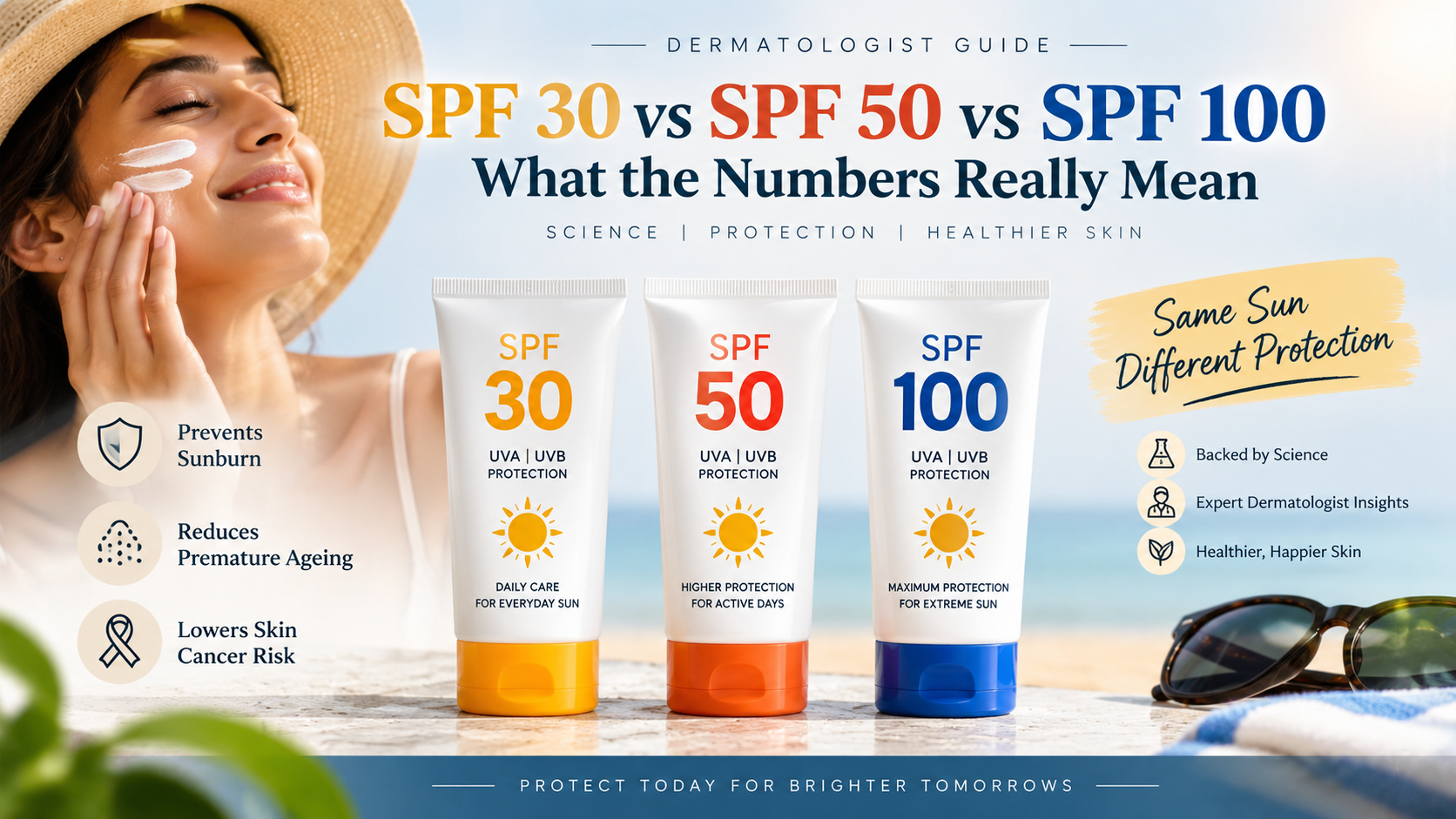
SPF 30 vs SPF 50 are commonly compared when choosing sunscreen, but these numbers do not simply represent percentages of UVB protection. This explanation is convenient, but it can make the differences between sunscreens appear smaller than they really are. SPF works as a biological protection factor based on the ultraviolet dose needed to produce sunburn, rather than simply as a percentage of ultraviolet radiation blocked.
Dr. Sasi Kiran Attili is a UK-trained dermatologist and board-certified dermatopathologist. When assessing sunscreen questions, the distinction between protection against erythema, or sunburn, and protection against pigmentation is particularly important. A high SPF can provide excellent protection against the biological endpoint measured in SPF testing without telling you everything you need to know about UVA protection or tanning.
Understanding SPF 30 vs SPF 50 vs SPF 100
SPF stands for Sun Protection Factor. In standardized testing, researchers apply sunscreen at approximately 2 mg/cm². They then compare the ultraviolet dose needed to produce minimal visible redness on protected skin with the dose required on unprotected skin.
Conceptually:
SPF = ultraviolet dose required to produce erythema on protected skin ÷ ultraviolet dose required on unprotected skin
An SPF 30 sunscreen therefore requires approximately 30 times the erythemally effective ultraviolet dose to produce the same endpoint under standardized laboratory conditions. SPF 50 corresponds to approximately 50 times that dose, while SPF 100 corresponds to approximately 100 times.
SPF should not be interpreted simply as the percentage of all ultraviolet B photons blocked. The SPF test measures a biological endpoint called erythema.
For additional guidance, see the FDA’s sunscreen information.
The familiar percentage figures arise mathematically from the protection factor:
| SPF | Approximate residual erythemally effective UV | Approximate attenuation |
|---|---|---|
| SPF 15 | 6.7% | 93.3% |
| SPF 30 | 3.3% | 96.7% |
| SPF 50 | 2.0% | 98.0% |
| SPF 100 | 1.0% | 99.0% |
Looking only at attenuation makes SPF 50 and SPF 100 appear very similar. Looking at residual exposure gives a different perspective: the theoretical residual erythemally effective dose falls from approximately 2% with SPF 50 to approximately 1% with SPF 100.
Understanding SPF 30 vs SPF 50 requires looking beyond the percentage of UVB protection.
Comparing sunscreens only by saying that SPF 50 blocks 98% while SPF 100 blocks 99% can obscure what the SPF scale actually represents.
SPF is a protection factor. SPF 100 represents twice the protection factor of SPF 50 under the standardized testing model. In terms of residual erythemally effective ultraviolet exposure, the theoretical amount remaining falls by approximately half.
That does not mean someone using SPF 100 should intentionally remain outdoors twice as long. Solar ultraviolet exposure varies with time of day, season, latitude, weather and other environmental conditions. Sweating, wiping, swimming, or simple physical contact can also remove sunscreen.
Real-world application introduces another limitation.Researchers test sunscreens at approximately 2 mg/cm². However, people often apply considerably less and may leave some areas unevenly covered.. Higher SPF can provide additional margin under imperfect use, but it does not eliminate the need for adequate application and appropriate reapplication.
The Diagnostic Approach to Sunscreen and Photoprotection
Choosing sunscreen is not always simply a matter of selecting the highest SPF number available.
The relevant clinical question is what the patient is trying to prevent.Someone primarily concerned about sunburn has a different photoprotection priority from someone receiving treatment for melasma, recurrent pigmentation, photosensitivity, or another condition aggravated by ultraviolet exposure.
A specialist assessment therefore considers the skin problem, the pattern of exposure, previous reactions to sunlight, pigmentation concerns, current treatments and whether inadequate sunscreen use may be contributing to the problem. SPF remains important, but clinicians interpret it within the wider clinical context.
Evidence-Based SPF 30 vs SPF 50 vs SPF 100 Strategies
SPF 30 already provides substantial protection against erythema when applied correctly and remains a reasonable minimum for routine photoprotection.
However, we should not dismiss higher SPF as meaningless. Two randomized natural-sunlight studies cited in the source article compared SPF 100+ with SPF 50+. In one split-face study involving 199 adults exposed outdoors for an average of 6.1 hours, more participants were judged to have greater sunburn on the SPF 50+ side than on the SPF 100+ side. A later five-day beach study reported a similar pattern.
Johnson & Johnson Consumer Inc. supported both studies, and company employees participated as investigators. This funding is relevant when assessing the evidence.
These trials also have an important limitation: they evaluated sunburn. They do not establish that SPF 100 is twice as effective as SPF 50 for preventing tanning, melasma, photoageing or skin cancer.
For practical sunscreen use, several conclusions follow from the available evidence:
- SPF 30, SPF 50 and SPF 100 are not identical.
- Higher SPF reduces the theoretical residual erythemally effective ultraviolet dose.
- Higher SPF does not justify deliberately extending time in the sun.
- Adequate and even application remains essential.
- Reapplication requirements do not disappear because the SPF number is higher.
- SPF alone does not describe the complete photoprotection profile of a sunscreen.
Why SPF Alone Is Not Enough for Tanning and Pigmentation
This is one of the most important limitations of choosing sunscreen purely by SPF.
The SPF test is based on erythema, an endpoint driven predominantly by UVB. Patients concerned about becoming darker, developing pigmentation or managing conditions such as melasma may therefore need to think beyond the SPF number.
UVA is particularly relevant to pigmentation. A sunscreen with a very high SPF can perform extremely well against the endpoint used in SPF testing while having a different UVA protection profile from another formulation.
For that reason, SPF should be understood primarily as a sunburn protection factor rather than as a complete anti-tanning score.
The actual UVA protection provided by the sunscreen becomes an additional and clinically important consideration when pigmentation is the main concern.
Who Should Seek a Second Opinion or Online Consultation?
A specialist consultation may be useful when sunscreen advice is part of a broader skin problem rather than simply a product-selection question.
This includes patients with persistent melasma or pigmentation despite regular sunscreen use, people who continue to tan or develop pigmentation while using high-SPF products, patients with suspected photosensitivity, and people whose skin condition repeatedly worsens after ultraviolet exposure.
Online consultation can also be useful for patients outside India who want a structured review of an existing diagnosis or photoprotection regimen, patients who have tried multiple approaches without understanding why pigmentation persists, and those confused by conflicting claims around SPF, UVA ratings or very-high-SPF sunscreens.
The aim is not simply to recommend a larger number on the bottle. It is to establish what biological problem needs to be prevented and whether the current photoprotection strategy addresses it.
Frequently Asked Questions
Is SPF 100 really better than SPF 50?
For the erythema endpoint used to determine SPF, SPF 100 represents a higher protection factor than SPF 50. Mathematically, the theoretical residual erythemally effective dose falls from approximately 2% with SPF 50 to approximately 1% with SPF 100.
That does not mean SPF 100 allows someone to spend twice as long in the sun, because real-world exposure and sunscreen performance vary considerably.
Are SPF 30 and SPF 50 practically the same?
No. Their percentage attenuation figures—approximately 96.7% and 98%—look similar, but they correspond to different residual erythemally effective doses.
SPF 30 leaves approximately 3.3% of that theoretical dose, while SPF 50 leaves approximately 2%. Whether the difference is clinically important depends on the situation and how the sunscreen is actually used.
Does higher SPF help if I apply too little sunscreen?
Higher SPF can provide some additional margin because real-world application is frequently lower than the approximately 2 mg/cm² used in standardized testing. It should not be viewed as a substitute for applying sunscreen adequately and evenly.
Underapplication can substantially reduce the protection achieved in practice.
Is SPF the best number to look at if I am concerned about tanning?
Not necessarily. SPF primarily reflects protection against an erythema endpoint and therefore does not fully describe UVA protection.
If tanning or pigmentation is the main concern, the UVA protection characteristics of the sunscreen become particularly important.
Can sunscreen and pigmentation problems be assessed through an online consultation?
Yes, many pigmentation and photoprotection questions can be assessed initially through an online consultation. The consultation can review the diagnosis, exposure pattern, current sunscreen use, other treatments and whether the chosen photoprotection strategy fits the clinical problem.
Some skin conditions may still require examination, testing or procedures in person if the available history and images are insufficient.
What does a dermatopathologist look for that a regular dermatologist might miss?
Dermatopathology provides additional training in correlating visible skin disease with the microscopic mechanisms underlying it. This can be useful when pigmentation, photosensitivity or another skin disorder does not behave as expected clinically.
It does not mean that every sunscreen question requires dermatopathology input. Its value is greatest in complex or diagnostically uncertain cases where the apparent symptom may be part of a broader skin disorder.
If You Are Still Tanning or Developing Pigmentation Despite Sunscreen
Persistent pigmentation despite using a high-SPF sunscreen does not automatically mean the sunscreen has “failed”. SPF answers only one part of the photoprotection question.
The underlying diagnosis, UVA protection, amount applied, application consistency and the reason for using sunscreen all matter.
If you have a complex pigmentation or photoprotection problem, have tried treatments without success, or need a specialist second opinion, Dr. Attili offers structured online consultations. [Book Online Consultation]