
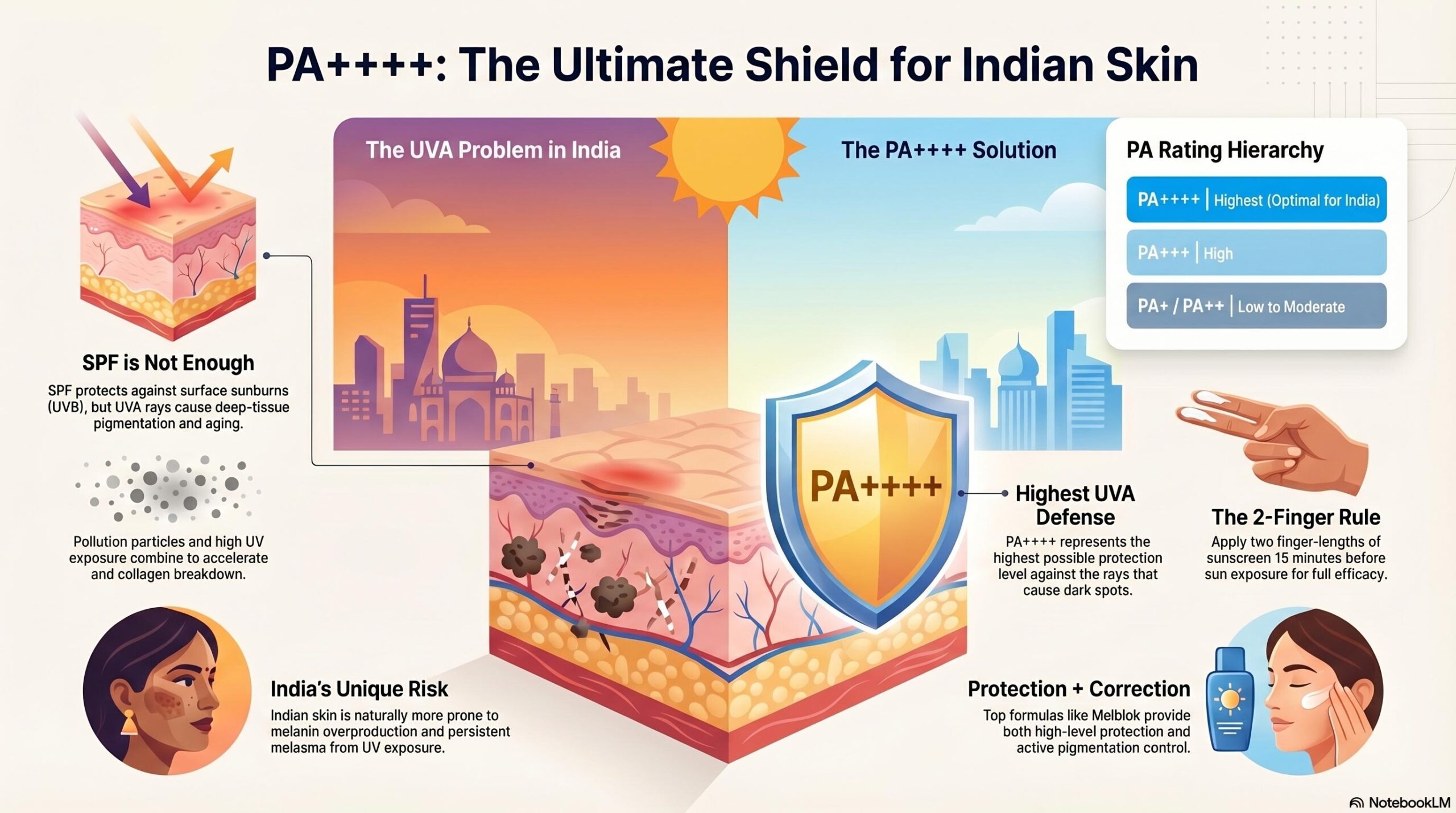
Choosing a sunscreen for pigmentation is more complicated than simply selecting the highest SPF on the shelf. UVA protection for pigmentation matters because UVA contributes to immediate pigment darkening, persistent pigmentation and photoageing, while repeated small exposures can accumulate over time. Dr. Sasi Kiran Attili is a UK-trained dermatologist and board-certified dermatopathologist who assesses patients with persistent and difficult-to-explain skin problems. Understanding what sunscreen labels actually measure can therefore help patients make more informed decisions without assuming that SPF, PA++++ or a five-star rating all mean the same thing.
Understanding UVA Protection for Pigmentation
Ultraviolet A, or UVA, covers wavelengths of approximately 320 to 400 nanometres. Compared with UVB, UVA penetrates more deeply into the skin and contributes importantly to immediate pigment darkening, more persistent pigmentation, photoageing and several photosensitive skin disorders.
For patients primarily worried about sunburn, SPF remains an extremely useful measurement. SPF, however, is based predominantly on the amount of ultraviolet exposure required to produce erythema, or sunburn. Pigmentation behaves differently, which is why a high SPF by itself does not provide all the information someone concerned about tanning, melasma or hyperpigmentation may want.
A more direct numerical measure of UVA protection is the UVA Protection Factor, usually abbreviated to UVA-PF. Conceptually, it compares the UVA dose needed to produce a defined pigment-darkening response on sunscreen-protected skin with the dose required on unprotected skin. A UVA-PF of 20 therefore represents a higher measured UVA protection factor than a UVA-PF of 10.
The difficulty for consumers is that this numerical value is rarely displayed prominently on sunscreen packaging. For people concerned about pigmentation, understanding UVA protection for pigmentation can make sunscreen selection more informed.
What Does PA++++ Mean?
The PA system converts numerical UVA-PF measurements into categories:
- PA+ corresponds to a UVA-PF of 2 to less than 4.
- PA++ corresponds to 4 to less than 8.
- PA+++ corresponds to 8 to less than 16.
- PA++++ corresponds to 16 or higher.
The last category is particularly important. PA++++ does not specify the exact UVA-PF once the product has crossed 16.
This means a sunscreen with a measured UVA-PF of 17 and another with a UVA-PF of 40 can both carry a PA++++ label. Both have crossed the threshold required for the category, but their measured UVA protection factors are not identical.
A 2026 in-vivo study examined 38 commercial SPF 50 and SPF 50+ sunscreens. Measured UVA-PF values ranged from 3.6 to 46.6. The average was 21.4. Five products had a UVA-PF above 30. Only a minority displayed a numerical UVA value on the packaging.
Why UVA Protection for Pigmentation Matters
Many clinicians advise patients to choose a high-SPF sunscreen and assume that it answers every question about tanning and pigmentation. The difficulty is that SPF, PA grading and Boots stars describe different aspects of photoprotection.
A PA++++ rating confirms that the product reaches a minimum UVA-PF threshold. It does not show how far beyond that threshold the product performs.
A five-star Boots rating therefore does not mean a UVA-PF of 50, and it does not mean that two five-star sunscreens provide identical absolute UVA protection. For somebody particularly concerned about pigmentation, understanding UVA protection for pigmentation can provide more specific information than the categorical PA rating alone.
There is a second problem with standard advice: pigmentation is not simply an acute event. A person can receive an exposure that causes no obvious visible tanning on one day but still contributes to cumulative pigmentation after repeated exposures.
Why Cumulative UVA Exposure Matters
When pigmentation persists despite regular sunscreen use, do not automatically assume that the sunscreen has “failed.” Start with a structured assessment. Consider the pattern of pigmentation, the timing and frequency of light exposure, the sunscreen used, how the patient applies it, and whether other mechanisms may contribute.
The source evidence also makes an important distinction between laboratory endpoints and what a patient sees in the mirror. Investigators can detect very small pigmentary changes that may not yet be visually obvious. In addition, everyday pigmentation may reflect repeated UVA exposure, UVB-driven delayed melanogenesis, visible light and individual skin biology rather than a single isolated ultraviolet dose.
For that reason, calculating an exact number of “safe minutes” before tanning is usually a much less useful clinical approach than understanding cumulative exposure over days and weeks.
Evidence-Based UVA Protection Strategies for Pigmentation
The most practical starting point is to recognise what each sunscreen label can and cannot tell you.
A high SPF provides useful information about protection against sunburn-producing ultraviolet exposure. A PA++++ rating indicates that the measured UVA-PF has reached at least 16. A Boots star rating provides information about how balanced the product’s UVA protection is relative to its UVB protection. None of these systems, used alone, gives a complete numerical description of every aspect of pigmentation protection.
Repeated exposure is particularly relevant. Experimental studies show that repeated exposure to fractions of an individual’s single-exposure tanning threshold can still cause pigmentation.
.In one study, six repeated exposures reduced the UVA dose needed to produce pigmentation to about half the single-exposure threshold. After twelve exposures, it fell to about one-third. After twelve exposures, it was approximately one-third, with pigmentation accumulating progressively over roughly 15 to 19 days.
Twenty minutes outdoors may appear to do nothing on one particular morning. Repeating that exposure daily can create a different biological result over the following weeks.
People should not automatically regard early morning and late afternoon exposure as zero-exposure periods. Measurements from Coimbatore in India found that useful amounts of UVA remained during these periods. UVB declined more substantially.
The more useful question is not, “How long can I remain outdoors before I tan?” Instead, ask, “How much cumulative UVA exposure am I receiving?” Also consider how effectively my protection reduces it.
This distinction is especially relevant for people with melasma or recurrent pigmentation. It can occur despite careful sunscreen use.
Who Should Seek a Second Opinion or Online Consultation?
A specialist review may be useful when pigmentation continues despite regular photoprotection. It may also help when different sources of sunscreen advice appear contradictory.
This includes people with treatment-resistant pigmentation. This is especially relevant when several products or treatments have not stopped the recurrence.
Patients told that “nothing can be done” may benefit from another review. The diagnosis, triggers and previous treatment response can be reassessed.
An online consultation can help clarify the history and next steps. Some pigmentation patterns may still require an in-person examination before a diagnosis can be confirmed.
Frequently Asked Questions About UVA Protection for Pigmentation
What does PA++++ actually mean?
PA++++ means that a sunscreen has reached a UVA Protection Factor of at least 16 under the relevant testing system. It does not tell you the exact UVA-PF once that threshold has been exceeded.
A product with UVA-PF 17 and another with UVA-PF 40 could therefore both be labelled PA++++ even though their measured UVA protection factors are substantially different.
Is a five-star Boots rating the same as very high UVA-PF?
No. Boots stars assess the balance between UVA and UVB protection rather than giving the absolute numerical UVA-PF.
A five-star sunscreen may have well-balanced UVA and UVB protection, but the star rating should not be interpreted as UVA-PF 50 or as proof that every five-star product provides identical UVA protection.
Can I calculate how many hours I can stay outside without tanning?
Not reliably. UVA-PF is measured using a defined laboratory pigmentary endpoint, while real-life pigmentation can reflect repeated UVA exposure, UVB, visible light, individual skin biology and cumulative changes across many days.
A short exposure that causes no visible tanning today can still contribute to pigmentation that becomes noticeable after repeated exposure.
Is sunlight before 9 AM or after 4 PM safe from pigmentation?
Those periods generally involve less total ultraviolet exposure than midday, particularly less UVB, but they are not necessarily free of UVA. Measurements cited in the source article show that UVA can remain present during morning and afternoon periods even when UVB has fallen more sharply.
For someone repeatedly exposed at the same time every day, cumulative exposure may therefore be more important than whether any single exposure produces visible tanning.
Can pigmentation be treated through an online consultation?
An online consultation can be useful for reviewing the history of pigmentation, previous treatments, photographs, exposure patterns and current sunscreen use.Patients outside India may also seek specialist input. They may want their history, previous diagnoses, treatment records and photographs reviewed systematically.
Some cases can be managed substantially through remote follow-up, while others may require direct examination or additional investigation before treatment decisions are finalised.
What does a dermatopathologist look for that a regular dermatologist might miss?
Dermatopathology is the interpretation of skin disease at a microscopic as well as clinical level. In complex cases, that background can be particularly useful when the visible pattern, clinical history and any previous biopsy findings do not fit neatly together.
Not every pigmentation problem requires a biopsy or dermatopathology assessment. The value is in recognising when the clinical picture warrants a deeper diagnostic question rather than repeatedly changing treatments without first reconsidering the diagnosis.
If you have a complex pigmentation case, have tried treatments without success, or need a specialist second opinion, Dr. Attili offers structured online consultations. [Book Online Consultation]