
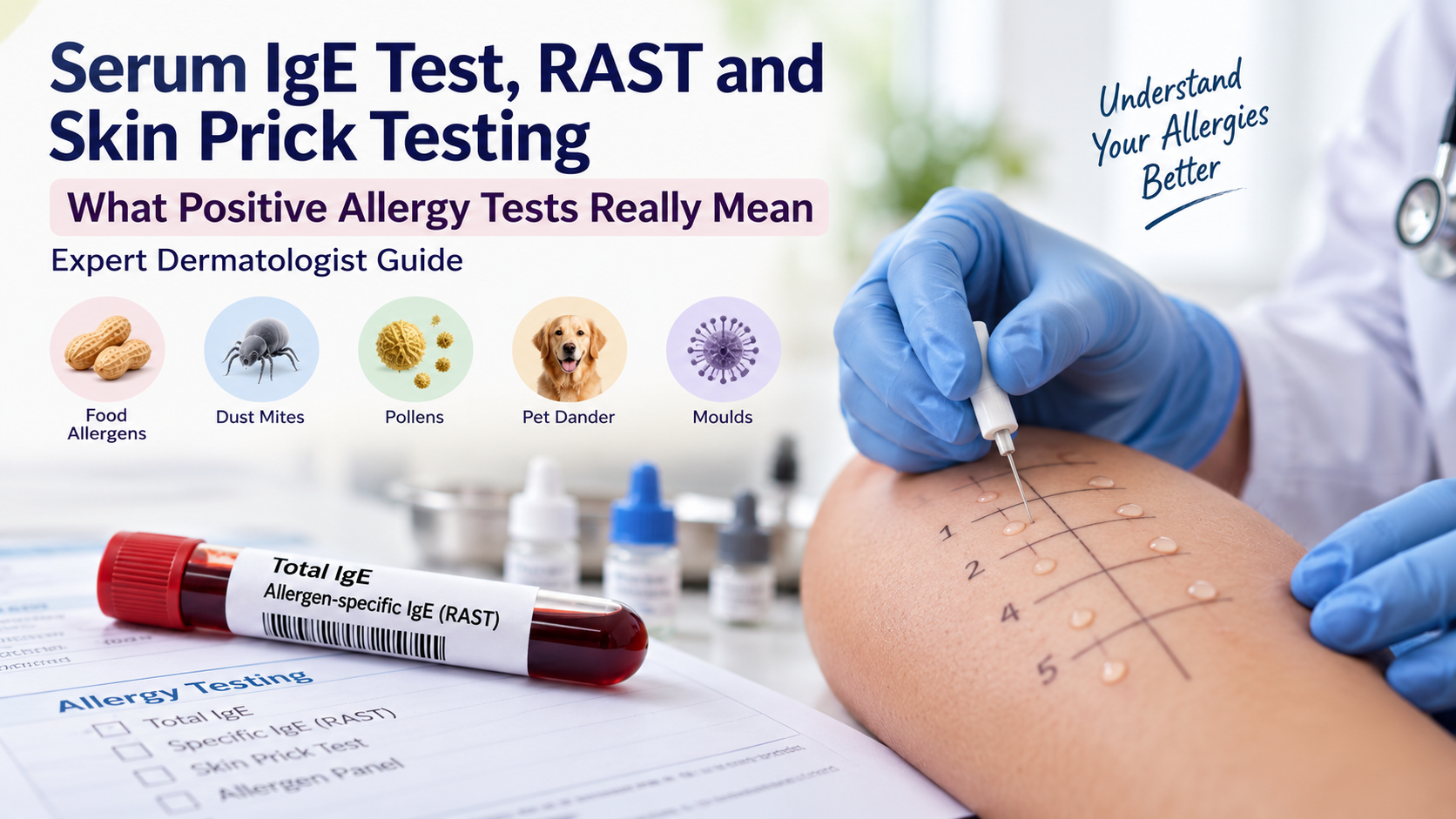
A serum IgE test, allergen-specific IgE test, RAST test, or skin prick test can help answer a specific clinical question. A positive allergy test does not automatically prove that an allergen causes eczema, urticaria, or another skin problem. Dr. Sasi Kiran Attili is a UK-trained dermatologist and board-certified dermatopathologist. He evaluates complex skin disease and cases where laboratory results and clinical symptoms do not agree.Understanding the difference between sensitisation and true clinical allergy is often the first step towards making sense of apparently abnormal allergy results.
Understanding Serum IgE Tests, RAST and Skin Prick Testing
IgE is an antibody involved in immediate, or Type I, allergic reactions. A serum IgE test can show whether overall IgE levels are high. Allergen-specific IgE testing checks for IgE against substances such as foods, pollens, or house-dust mites. Skin prick testing measures how the skin reacts to a small amount of an allergen extract.
The critical distinction is that these investigations primarily identify sensitisation. Sensitisation means the immune system recognises a particular allergen and has produced IgE against it. Clinical allergy means exposure to that allergen reproducibly produces symptoms.
Someone may therefore have positive specific IgE to pollen yet experience no symptoms when exposed to pollen. Equally, a person can have a positive food test while continuing to eat that food without urticaria, swelling, vomiting, wheezing or another immediate reaction.
This distinction means doctors should always interpret laboratory results alongside the clinical history.
For more information about allergy testing, visit the American Academy of Allergy, Asthma & Immunology (AAAAI).
Why Serum IgE and Allergy Tests Often Fail to Answer the Real Question
The problem is not necessarily that the serum IgE test is technically incorrect. The problem is that the test may be answering a different question from the one the patient needs answered.
For example, total IgE is frequently elevated in people with atopic dermatitis. Yet the absolute value does not reliably measure disease activity in an individual patient. Severe eczema can occur despite a normal IgE level, while another patient may have a markedly elevated IgE concentration with relatively little active eczema.
Large allergen-specific IgE panels can cause similar problems when doctors order them without a clear clinical question. Highly atopic patients may test positive to multiple foods or environmental allergens. Some results may show sensitisation without a clinically relevant reaction.
A positive laboratory report should not automatically lead patients to avoid foods or environmental exposures.
The Diagnostic Approach to a Positive IgE or Skin Prick Test
Interpretation begins with the history.
For suspected IgE-mediated food allergy, the key question is what happens after someone eats the food.True immediate food allergy usually causes symptoms within minutes to approximately one or two hours. Depending on the reaction, symptoms may include urticaria, angioedema, itching, vomiting, abdominal symptoms, wheeze, breathlessness or anaphylaxis.
Reproducibility also matters. A food repeatedly eaten without symptoms is less likely to explain unrelated chronic skin complaints simply because an allergy panel later becomes positive.
The same principle applies to suspected inhaled allergens. A specialist assessment looks for a credible relationship between exposure and symptoms rather than relying on the laboratory report alone.
When the history is uncertain, a food-and-symptom diary can sometimes clarify whether a plausible pattern exists. In selected cases, targeted specific-IgE testing or skin-prick testing can then help investigate a defined question. If clinically important uncertainty about food allergy remains, a medically supervised oral food challenge is the reference diagnostic procedure.
Evidence-Based Treatment Strategies After Allergy Testing
The aim is not to “treat” a positive allergy result or reduce an IgE number simply because it falls outside the laboratory range. Doctors should base management on the patient’s clinical disease and genuinely relevant allergens.
In atopic dermatitis, doctors should not generally use total IgE as a stand-alone marker of eczema improvement or worsening.. A patient can improve clinically while the IgE remains high.
In chronic spontaneous urticaria, routine searches for foods, pollen, dust mites or other external allergens are also unlikely to explain most cases. Contemporary international guidance recognises chronic spontaneous urticaria as a mast-cell-driven disorder in which autoimmune mechanisms are important. This is different from assuming that recurrent wheals are being caused by an unidentified food allergy.
Targeted allergy investigation is more useful when there is a clear exposure-response pattern, genuine uncertainty between several possible allergens, or a management decision that would change according to the result.
Total IgE does have selected specialist uses. For example, pretreatment total IgE is used with body weight in determining approved omalizumab dosing in severe allergic asthma. In chronic spontaneous urticaria, omalizumab dosing does not depend on total IgE.
The broader principle remains the same: investigate and treat the clinical problem rather than pursuing an isolated laboratory abnormality.
Who Should Seek a Second Opinion or Online Consultation?
A specialist review can be particularly useful when allergy testing has created more questions than answers.
This includes patients with treatment-resistant eczema who receive long lists of foods to avoid after broad allergy panels. It also includes patients with chronic urticaria who keep searching for an external allergen despite ongoing symptoms. Some patients have positive specific-IgE or skin-prick results that do not match their daily symptoms.
Patients outside India may also use an online consultation to obtain structured review of their history, photographs where relevant, previous dermatology records and existing allergy-test results before deciding what further assessment is justified.
A second opinion may also help patients who hear that “nothing can be done” or feel confused by conflicting claims about positive allergy tests.
An online consultation cannot itself perform a skin-prick test or supervised food challenge. Its role is to establish whether further testing is likely to answer a meaningful clinical question and whether an in-person procedure is necessary.
Frequently Asked Questions
What does a high total serum IgE mean?
A serum IgE test measures IgE levels in the blood. A high result does not identify the allergen causing symptoms. It also does not reliably measure eczema severity.
Does a positive RAST or specific IgE result mean I am definitely allergic?
No. A positive specific-IgE test mainly shows sensitisation to that allergen. Clinical allergy requires a clear link between exposure and symptoms. Someone who regularly eats a food without an immediate reaction should not be labelled allergic solely because a blood test is positive.
How accurately does a skin prick test diagnose food allergy?
Skin-prick testing can show sensitisation. It does not reproduce the full process of eating, digesting, and absorbing a food. Some people may have a positive result but tolerate the food normally. Doctors should interpret the result with the patient’s history.
When is an oral food challenge needed?
Doctors may recommend a medically supervised oral food challenge when a serum IgE test leaves uncertainty. The test checks whether eating the food causes symptoms. It remains an important diagnostic test for IgE-mediated food allergy.
What does a serum IgE test show?
A serum IgE test measures IgE levels in the blood. A high result may suggest allergic sensitisation, but it does not confirm that a specific allergen is causing symptoms. Doctors should interpret the result with the patient’s clinical history.
Can abnormal IgE or allergy-test results be assessed through an online consultation?
Yes.An online consultation can review your symptoms, food or environmental exposures, and IgE or skin-prick results. It can also help assess previous diagnoses and treatments. Some tests require direct exposure. These tests must be performed in person when needed.
What does a dermatopathologist look for that a regular dermatologist might miss?
Dermatopathology training adds expertise in correlating clinical skin findings with microscopic disease patterns when a biopsy is relevant to diagnosis. However, interpretation of IgE, RAST and skin-prick testing itself still depends primarily on the exposure history, symptom pattern and the specific clinical question rather than on skin biopsy findings.
If you have a complex eczema, chronic urticaria or suspected allergy case, have undergone repeated testing without a clear explanation, or need a specialist second opinion on conflicting allergy results, Dr. Attili offers structured online consultations. [Book Online Consultation]