
By Dr. Sasi Kiran Attili, Consultant Dermatologist & Dermatopathologist
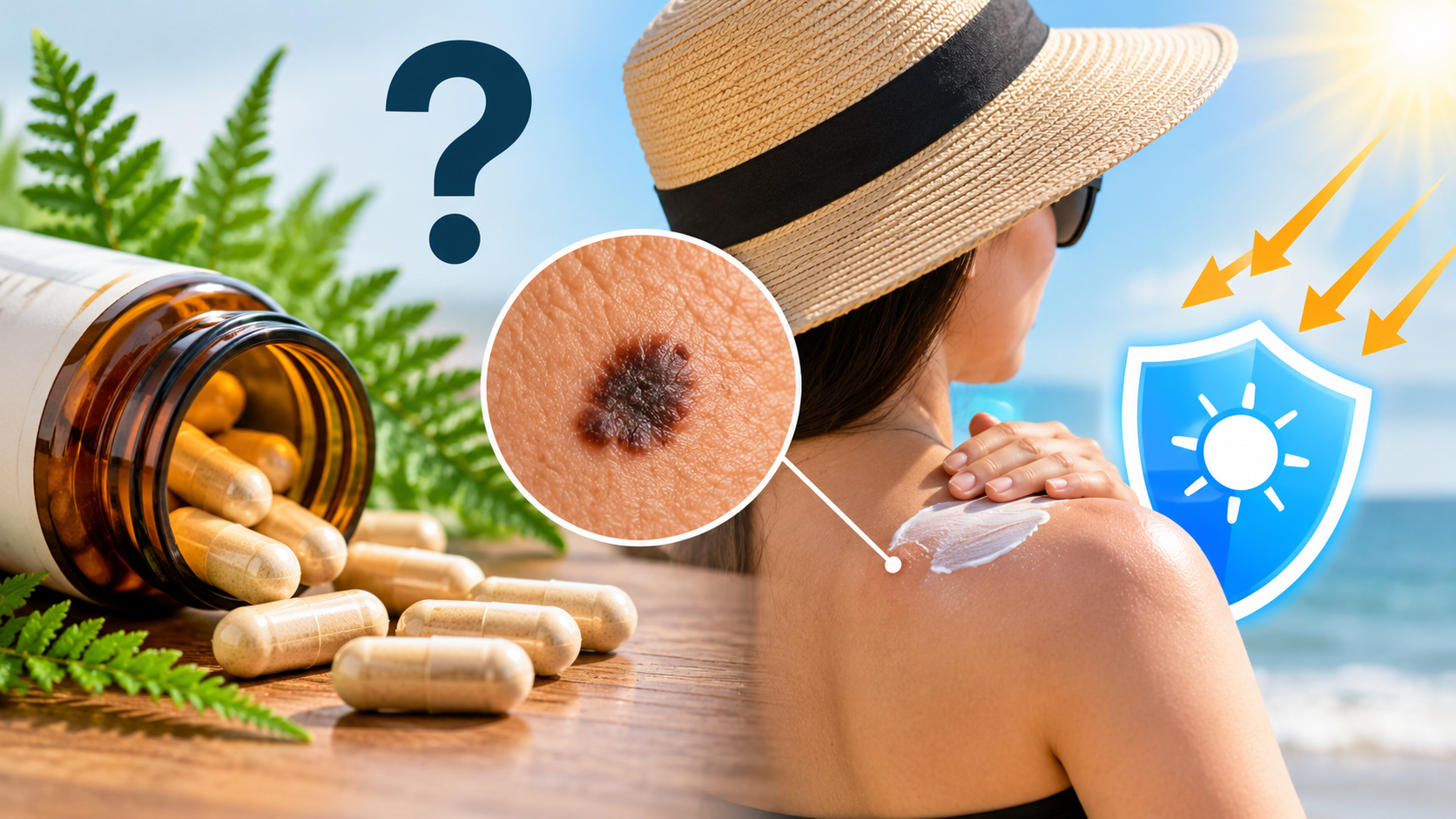
Oral sunscreen pills are supplements marketed for skin protection. Oral sunscreen pills are not proven to prevent skin cancer. Some contain Polypodium leucotomos, a tropical fern extract, while others contain antioxidants, carotenoids or vitamins.
But can these supplements actually prevent skin cancer?
The short answer is that no convincing human clinical evidence currently demonstrates that botanical oral photoprotective supplements prevent melanoma, basal cell carcinoma or squamous cell carcinoma. Some can reduce UV-induced redness, but that is not the same as preventing cancer.
For people concerned about skin cancer, this distinction is particularly important.
Can Oral Sunscreen Pills Prevent Skin Cancer?
The term oral sunscreen is somewhat misleading.
Conventional sunscreens work by reducing the amount of ultraviolet radiation reaching the skin. Oral photoprotective supplements work differently. The body absorbs these ingredients, which may influence inflammatory, antioxidant and other biological responses to ultraviolet exposure.
Researchers have studied Polypodium leucotomos most extensively. This fern extract may affect sunburn, UV-related inflammation and certain photosensitivity disorders.
These effects are scientifically plausible, but the central question is whether they translate into meaningful clinical protection.
What Does the Evidence Show About Oral Sunscreen Pills??
Researchers commonly evaluate oral photoprotection by measuring the minimal erythema dose (MED)—the amount of ultraviolet radiation required to produce visible skin redness.
In a 2025 randomized, placebo-controlled trial involving 54 fair-skinned volunteers, eight weeks of a supplement containing Polypodium leucotomos, red-orange extract and several vitamins increased MED by approximately 23.8%.
This suggests that the supplement made the skin somewhat more resistant to UV-induced redness.
However, it did not significantly reduce pigmentation compared with placebo.
Other studies have reported increases in UVA or UVB erythema thresholds following treatment with Polypodium-containing preparations.
These are measurable biological effects. But reducing sunburn is only one part of photoprotection.
Does Less Sunburn Mean Less DNA Damage?
Ultraviolet radiation can damage DNA in skin cells. Accumulation of mutations contributes to the development of skin cancers, including squamous cell carcinoma, basal cell carcinoma and melanoma.
A crucial question is whether oral supplements reduce this underlying damage—not merely the visible inflammation.
A 2026 human study reported increased resistance to UVA-induced erythema following use of a Polypodium leucotomos-containing preparation.
Yet researchers found no significant reduction in UV-induced thymidine dimers, a particular form of DNA damage, measured in skin biopsies or urine.
A related UVB study also reported improved erythema resistance without a significant reduction in the measured DNA-damage endpoint.
These findings do not prove that oral photoprotectants have no beneficial molecular effects. However, they demonstrate an important limitation:
Less redness does not necessarily mean less DNA damage, and it does not establish cancer prevention.
Can Polypodium Leucotomos Prevent Skin Cancer?
Laboratory and experimental studies suggest that Polypodium leucotomos can influence oxidative stress, inflammation and cellular responses associated with ultraviolet injury.
However, no adequately powered human clinical trial has established that taking this extract reduces the incidence of melanoma or other skin cancers.
An experimental study published in 2026 also reported that dietary Polypodium leucotomos failed to prevent chronic UV-induced skin tumour formation in hairless mice.
Animal studies cannot determine whether a treatment prevents cancer in humans. Nevertheless, this result reinforces the need for long-term human trials rather than relying on laboratory mechanisms or short-term erythema measurements.
Until such studies become available, readers should treat claims that oral photoprotective supplements prevent skin cancer with caution.
How Does This Compare With Conventional Sunscreen?
Conventional sunscreens have a substantially stronger evidence base for skin cancer prevention.
An Australian randomized trial involving 1,621 adults compared regular daily sunscreen application with discretionary use. Follow-up research demonstrated a reduction in squamous cell carcinoma tumours and reported fewer invasive melanomas among participants assigned to regular sunscreen use.
Researchers observed relatively few melanoma cases, so these findings do not prove that sunscreen eliminates melanoma risk.
Nevertheless, this represents evidence based on actual skin cancer outcomes rather than simply measuring how much ultraviolet exposure produces redness.
Current dermatological recommendations continue to emphasise:
- Seeking shade and avoiding unnecessary intense UV exposure.
- Wearing protective clothing and wide-brimmed hats.
- Applying broad-spectrum, water-resistant SPF 30 or higher sunscreen to exposed skin, with reapplication approximately every two hours outdoors and after swimming or sweating.
- Avoiding tanning beds.
- Seeking assessment for suspicious or changing skin lesions.
Research has not demonstrated that oral supplements can replace any of these measures.
Are Oral Sunscreen Pills Effective?
Possibly, but for different reasons.
Limited clinical evidence suggests that oral Polypodium leucotomos may help some patients with abnormal sensitivity to sunlight, including certain photodermatoses.
In selected cases, patients with persistent symptoms despite appropriate conventional photoprotection might consider an oral supplement as an additional measure.
However, the supporting studies are generally small. Therefore, rigorous clinical trials have not consistently demonstrated these benefits.
Botanical supplements also vary in composition. Evidence for one standardized extract cannot automatically be applied to every commercially available preparation.
Short-term safety findings are reasonably reassuring for some studied products, but evidence about prolonged use and less common adverse effects remains limited.
For someone primarily concerned about skin cancer prevention, the additional expense of an oral supplement is difficult to justify without demonstrated clinical benefit.
Who Should Be Particularly Careful About Skin Cancer?
People with fair skin, substantial cumulative sun exposure, a history of severe sunburns, numerous atypical moles, previous skin cancer, relevant family history or immunosuppression may face an increased risk.
These individuals may require more than routine sun protection, including periodic professional skin examinations where clinically indicated.
A changing mole, a persistent non-healing sore, an unexplained bleeding lesion or a new suspicious growth should be assessed directly by an appropriately qualified clinician.
Taking an oral photoprotective supplement must never delay the assessment of a suspicious skin lesion.
Frequently Asked Questions
Do Oral Sunscreen Pills Protect Against Melanoma?
There is currently no convincing human clinical evidence that botanical oral photoprotective supplements reduce melanoma incidence.
Can Polypodium Leucotomos Replace SPF 50 Sunscreen?
No. An oral supplement does not block incoming UV radiation in the way a properly applied topical sunscreen does, and it has not been shown to provide equivalent protection.
Are Oral Sunscreen Pills Worth Taking If I Have Previously Had Skin Cancer?
There is insufficient evidence to recommend botanical oral photoprotectants routinely for preventing another skin cancer. People with previous skin cancer should prioritise appropriate sun protection, surveillance and recommendations from their treating dermatologist.
Can a Dermatologist Assess a Suspicious Mole Online?
Photographs and clinical history may provide useful preliminary information, but they cannot reliably exclude melanoma or other skin cancers. Suspicious lesions require appropriate in-person assessment, often including dermoscopy and sometimes biopsy.
The Bottom Line
Oral photoprotective supplements may reduce certain short-term effects of ultraviolet exposure, but they have not been proven to prevent skin cancer.
For people at increased risk of melanoma or other skin cancers, conventional photoprotection and appropriate clinical surveillance remain the priorities.
An oral supplement may have a limited adjunctive role in selected photosensitivity disorders. That is very different from recommending it as a routine cancer-prevention treatment.
When Specialist Input May Help
If you are uncertain about a supplement marketed for sun protection, or would like to better understand the evidence behind different preventive strategies, OnlineSkinSpecialist.com offers educational dermatology commentary on anonymised clinical scenarios.
This is an advisory-only educational service, not a medical consultation. It does not provide prescriptions or replace an in-person skin examination. Suspicious lesions should be assessed promptly by a local healthcare professional.
References and Further Reading
- Keršmanc P, et al. Effects of Eight-Week Supplementation Containing Red Orange and Polypodium leucotomos Extracts on UVB-Induced Skin Responses. Nutrients. 2025;17:1240. https://doi.org/10.3390/nu17071240
- Faisal A, et al. Changes in Ultraviolet A Radiation-Induced Thymidine Dimers and Erythema After Oral Nicotinamide or Polypodium leucotomos Extract in Healthy Volunteers. Photochemical & Photobiological Sciences. 2026;25:845–852. https://doi.org/10.1007/s43630-026-00884-2
- Faisal A, et al. Changes in Ultraviolet B Radiation-Induced DNA Damage and Erythema After Oral Nicotinamide and Polypodium leucotomos. Photochemical & Photobiological Sciences. 2025. https://doi.org/10.1007/s43630-025-00807-7
- Boostani M, et al. Dietary Polypodium leucotomos Supplementation Minimally Alters Acute UV-Induced Edema and Erythema and Fails to Protect Against Chronic UV-Induced Photocarcinogenesis in SKH1 Mice. Journal of Investigative Dermatology. 2026. https://doi.org/10.1016/j.jid.2026.08.020
- Green AC, et al. Reduced Melanoma After Regular Sunscreen Use: Randomized Trial Follow-up. Journal of Clinical Oncology. 2011;29:257–263. https://doi.org/10.1200/JCO.2010.28.7078
- American Academy of Dermatology. How to Prevent Skin Cancer. https://www.aad.org/public/diseases/skin-cancer/how-to-prevent
- US Food and Drug Administration. Warning Letter: Sunergized LLC, May 18, 2018. https://www.fda.gov/inspections-compliance-enforcement-and-criminal-investigations/warning-letters/sunergized-llc-548703-05182018