
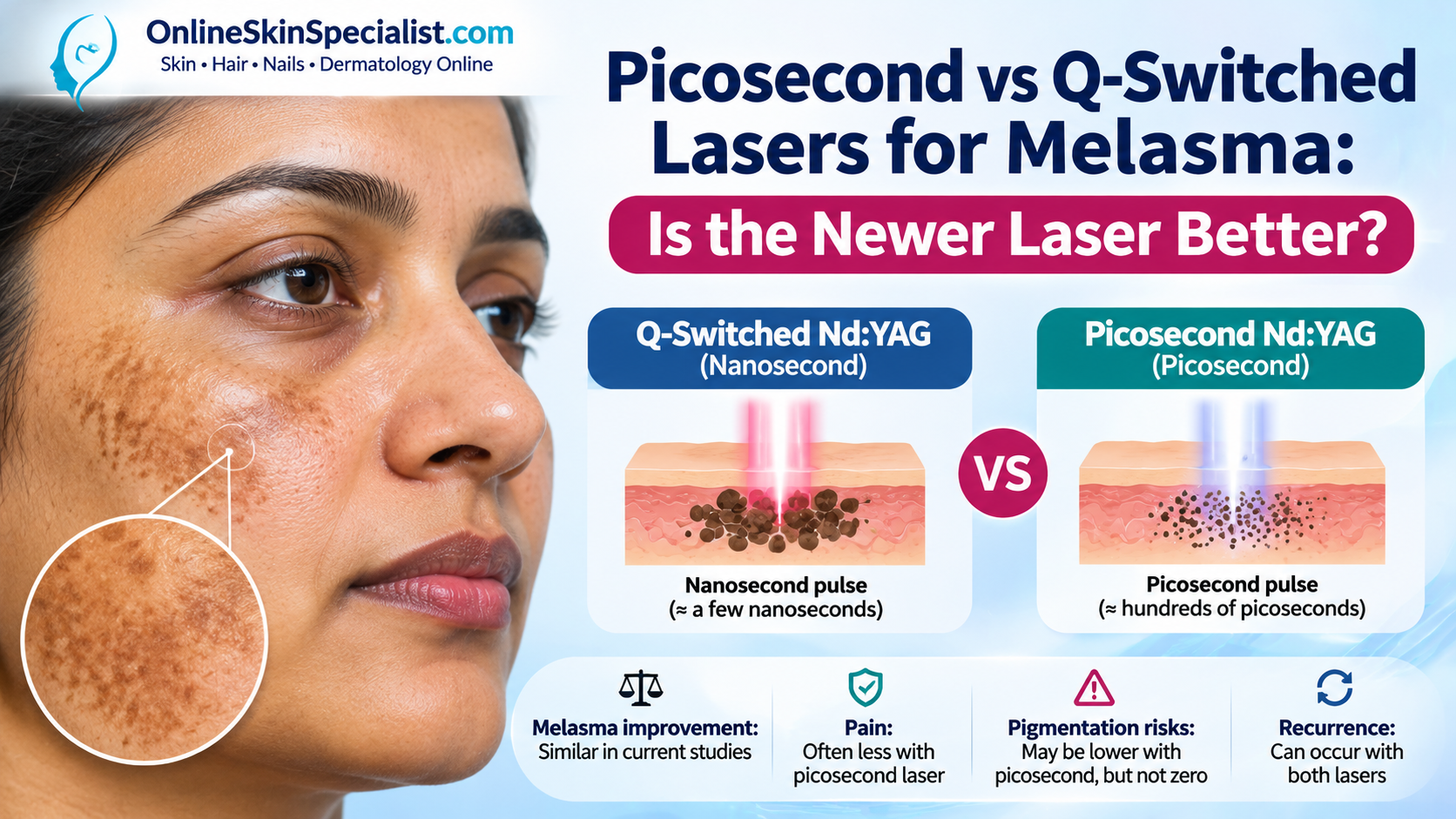
Picosecond lasers are often promoted as a more advanced treatment for facial pigmentation. They can offer genuine advantages, including less procedural discomfort and lower rates of some pigmentary complications. However, current comparative evidence has not established that picosecond Nd:YAG lasers produce better or more durable results than conventional Q-switched Nd:YAG for melasma.
That does not mean the two treatments are equivalent. It means the available studies have not demonstrated a clear clinical advantage for one over the other.
What Is the Difference Between Picosecond and Q-Switched Lasers?
Conventional Q-switched Nd:YAG lasers deliver energy in pulses lasting a few nanoseconds. Picosecond Nd:YAG lasers use substantially shorter pulses, typically measured in hundreds of picoseconds. One nanosecond equals 1,000 picoseconds.
Both systems can operate at the same wavelengths, including 1064 nm and 532 nm. The principal distinction in a same-wavelength comparison is pulse duration, although other technical differences—including spot size, fluence, beam profile and treatment handpieces—also influence results.
Shorter pulses produce higher peak power for a given delivered fluence and can increase the photoacoustic contribution to pigment fragmentation. But an appealing physical explanation does not establish that patients with melasma will experience better or longer-lasting improvement.
What Do Comparative Studies Show for Melasma?
A randomised split-face trial published in 2026 compared 1064-nm picosecond and Q-switched Nd:YAG lasers in 16 Asian women with Fitzpatrick skin types III–IV. Both sides of the face improved.
The investigators found no statistically significant difference in melasma severity scores, patient-rated aesthetic improvement or six-month recurrence between treatments. Picosecond treatment was less painful after the first session (Wu et al., 2026).
This was a small trial. Its picosecond protocol also included a fractional handpiece, so the comparison was not simply a test of pulse duration. Importantly, failure to demonstrate a statistically significant difference is not proof that the treatments are equally effective.
A broader meta-analysis published in 2025 examined 20 randomised trials and one retrospective study involving 971 patients. For naturally occurring pigmentation, picosecond and nanosecond lasers did not show a statistically significant difference in the proportion achieving substantial clearance (relative risk 1.06; 95% confidence interval 0.85–1.31). However, the review combined different conditions, laser wavelengths and treatment protocols (Wu et al., 2025).
The findings cannot be interpreted as definitive evidence for melasma alone.
Are Picosecond Lasers Safer for Darker Skin?
There is a genuine reason to consider picosecond technology.
The 2025 meta-analysis found significantly lower rates of post-inflammatory hyperpigmentation and hypopigmentation with picosecond treatment. Pain scores were also lower. These outcomes matter, especially for patients with darker skin, in whom additional pigmentation can be a major treatment concern.
Nevertheless, the pooled results involved different devices and conditions, including tattoo removal. They do not tell us precisely how much a 1064-nm picosecond Nd:YAG reduces the risk of persistent pigmentary changes compared with a conventional 1064-nm Q-switched Nd:YAG in Indian or other darker skin phototypes.
Neither laser is free from complications. Treatment parameters, skin type, recent sun exposure, underlying diagnosis and previous pigmentation reactions all influence risk.
Why Melasma Requires a Different Approach From Tattoo Removal
Tattoo removal and melasma involve different biological problems.
Laser tattoo removal targets externally introduced ink particles. Melasma is a chronic pigmentation disorder influenced by sunlight, visible light, hormones and individual susceptibility. Even after successful treatment, pigmentation may recur.
A laser that fragments tattoo ink efficiently is therefore not necessarily the best treatment for melasma.
For most patients, management begins with consistent photoprotection, including broad-spectrum sunscreen and, where appropriate, tinted formulations containing iron oxides for visible-light protection. A dermatologist may recommend prescription depigmenting treatments when appropriate.
Dermatologists may use lasers in selected patients as an additional treatment.. Repeated procedures without a clear maintenance plan may provide temporary improvement without preventing recurrence.
Before Choosing a Laser, Confirm the Diagnosis
Not every brown patch on the face is melasma.
Post-inflammatory hyperpigmentation, lichen planus pigmentosus, pigmented contact dermatitis and dermal melanocytosis can resemble melasma clinically, but they do not necessarily respond to the same treatment.
The distribution, colour, duration, symptoms and previous treatment history are importantClinical photographs can help the dermatologist assess pigmentation..
A patient who has been labelled as having “stubborn melasma” may benefit more from reassessing the diagnosis than from switching to a newer laser.
Questions Worth Asking Before Treatment
A meaningful discussion with the treating dermatologist should cover the exact diagnosis, the laser wavelength and treatment protocol, the expected degree of improvement, the number of sessions likely to be required and the risk of worsening pigmentation.
It is also worth asking how long results are expected to last, what maintenance treatment is planned and whether the proposed laser has been compared with established alternatives in patients with a similar skin type.
A newer machine is not, by itself, evidence of a better treatment plan.
Frequently Asked Questions
Is picosecond laser treatment better than Q-switched Nd:YAG for melasma?
Current comparative studies have not demonstrated a consistent advantage in melasma improvement or durability. The evidence remains limited and does not establish equivalence.
Is picosecond laser treatment less painful?
Comparative studies suggest that it often is. Reduced procedural pain is a meaningful advantage, even if pigment clearance is similar.
Does picosecond treatment prevent melasma from returning?
No convincing evidence demonstrates that it prevents recurrence. Melasma is chronic and requires ongoing preventive care.
Can laser treatment make pigmentation worse?
Yes. Post-inflammatory hyperpigmentation and hypopigmentation are recognised risks. Appropriate diagnosis, patient selection and treatment parameters are important.
When Can a Specialist Review Help?
If you have persistent facial pigmentation, have undergone multiple procedures without lasting improvement, or are considering an expensive laser treatment, reviewing the diagnosis and previous treatment history may be more useful than choosing a device by its marketing claims.
At Online Skin Specialist, Dr. Sasi Kiran Attili, a UK-trained dermatologist and dermatopathologist, provides educational specialist reviews of submitted skin concerns. These can help you understand possible diagnoses, treatment evidence and questions to discuss with your treating clinician.
The service is advisory only. It does not replace an in-person assessment, provide laser procedures or issue prescriptions.