
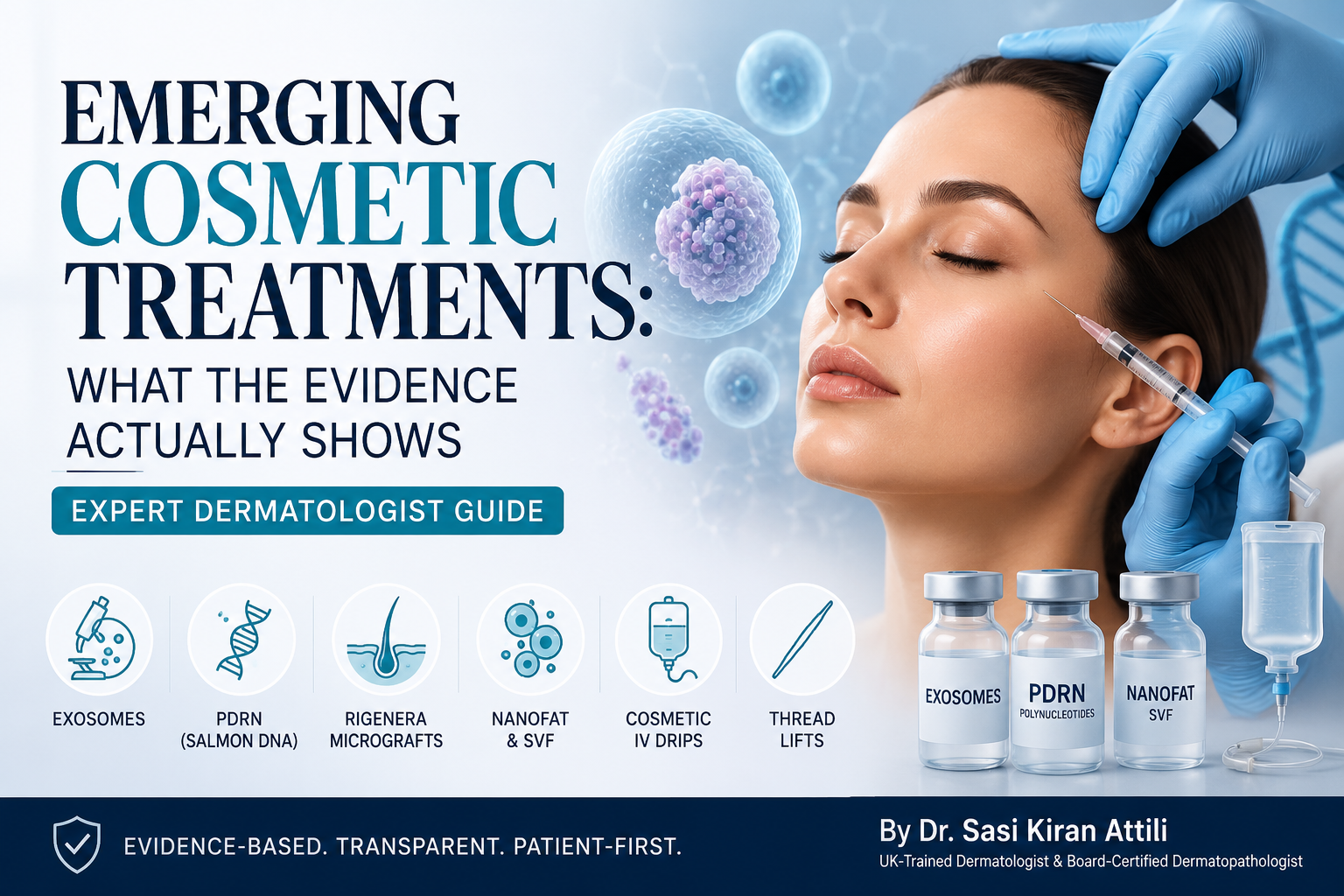
Emerging cosmetic treatments are frequently promoted as breakthroughs for hair loss, pigmentation, skin ageing and facial rejuvenation. Exosomes, polynucleotides, “salmon DNA,” regenerative injections, intravenous vitamin drips and thread lifts may sound scientifically advanced, but that does not automatically mean their benefits have been established in reliable clinical trials. Dr. Sasi Kiran Attili is a UK-trained dermatologist and board-certified dermatopathologist who evaluates treatment claims by considering the diagnosis, quality of evidence, expected duration of benefit and potential risks. This guide explains what patients should understand before committing to these increasingly advertised procedures.
Understanding Emerging Cosmetic Treatments: Benefits and Risks
Emerging cosmetic treatments often begin with a scientifically plausible idea. Exosomes can carry signalling molecules between cells. Polynucleotides and PDRN contain DNA fragments that may influence tissue repair. Micrografts and processed fat contain cellular or tissue components that could potentially affect hair growth or healing. Threads can mechanically reposition tissue, while intravenous products introduce vitamins, antioxidants or other substances directly into the circulation.
Plausibility, however, is only the beginning of clinical evaluation. A treatment must also be studied in appropriate patients, compared with credible alternatives, delivered using reproducible protocols and followed for long enough to determine whether the benefit is meaningful and durable.
A 2026 consensus position statement from a task force of the Association of Cutaneous Surgeons of India reviewed six increasingly promoted treatments. The authors found that several were being used or advertised despite substantial limitations in study quality, standardisation and long-term safety data.
Why Standard Treatments Often Fail
The consensus statement does not establish that standard treatments routinely fail. Patients often begin researching experimental or regenerative procedures after receiving an incomplete response, experiencing adverse effects, becoming frustrated with slow improvement or being promised a faster alternative.
Before assuming that an established treatment has failed, the diagnosis, treatment choice, duration, adherence, follow-up and expected outcome should be reviewed. A procedure that appears more advanced may not correct an inaccurate diagnosis or an unsuitable treatment plan. Moving directly to an expensive emerging procedure can therefore add uncertainty without resolving the reason that earlier care was unsuccessful.
The Diagnostic Approach to Emerging Cosmetic Treatments
A structured evaluation begins by defining the problem being treated. Hair shedding, patterned hair loss, scarring alopecia, pigmentation, textural change and facial laxity have different causes and cannot be managed through one regenerative-treatment pathway.
The assessment should review the diagnosis, previous treatments, photographs, relevant medical history and the precise outcome the patient expects. The proposed product or device should then be examined separately: what it contains, how it is manufactured, whether the procedure is standardised, what evidence supports the intended use and whether the expected benefit justifies the risks and cost.
When uncertainty remains, further clinical investigation may be more valuable than immediately adding another procedure.
Evidence-Based Treatment Strategies for Emerging Cosmetic Treatments

An evidence-based strategy does not reject innovation. It separates treatments that are established from those that remain investigational, conditionally supported or dependent on careful patient selection.
Exosome Treatments
Exosomes are microscopic packages released by cells that contain proteins, lipids and genetic material. Laboratory research suggests that they may influence inflammation, wound healing, collagen activity and hair growth.
Commercial products differ substantially in their cellular source, composition, purification and manufacturing. Most supporting evidence comes from laboratory studies, animal research, case reports or small clinical studies. Long-term safety remains uncertain.
The JCAS task force classified the evidence as very low level and advised that commercially available exosome products should be regarded as experimental rather than routine treatment.
Polynucleotides and PDRN
Polynucleotides and polydeoxyribonucleotides, often marketed as PN, PDRN or “salmon DNA,” are DNA fragments usually derived from salmon or trout. They are promoted for fine lines, under-eye rejuvenation, pigmentation, scars, hair loss and wound healing.
Some small studies report improvement, but products, injection schedules, doses and outcome measurements vary considerably. Follow-up periods are commonly short, and there is no widely accepted protocol establishing the optimal product, treatment frequency or duration of benefit.
Current evidence therefore does not support presenting PN or PDRN as a predictable routine treatment for every advertised indication.
Rigenera Micrografts
Rigenera involves taking very small samples of scalp tissue, mechanically processing them and injecting the resulting suspension into areas of hair loss.
Small studies have reported changes in hair density or thickness. However, much of the published evidence comes from small, non-randomised studies with limited follow-up. The consensus statement considered the evidence for pattern hair loss limited and supported only a cautious recommendation.
Device clearance should not be interpreted as proof that every treatment performed with that device is clinically effective. Patients should not be told that Rigenera is an established replacement for standard pattern-hair-loss treatment.
Nanofat and Stromal Vascular Fraction
Nanofat and stromal vascular fraction procedures begin with fat obtained from the patient. The tissue is processed to produce material containing supporting cells, tissue components and growth factors before being injected into the scalp.
The available studies use substantially different methods. Some use enzymes, others rely on mechanical processing, and some combine the material with platelet-rich plasma or microneedling. These differences make it difficult to identify which component, if any, produced the reported improvement.
The task force called for better-designed trials, standardised protocols and longer safety follow-up. These procedures should therefore be considered selectively, with careful documentation and explicit informed consent about the uncertainty.
Emerging Cosmetic Treatments: Cosmetic Intravenous Drips
Intravenous glutathione, vitamin C, NAD+, vitamin mixtures and antioxidant drips are promoted for skin brightening, anti-ageing, detoxification, immunity, energy and hair or nail growth.
The consensus statement found no strong evidence supporting these routine cosmetic uses in otherwise healthy individuals. Intravenous glutathione may produce temporary lightening in some patients, but the response is inconsistent and may reverse after treatment stops. No accepted long-term cosmetic dosing protocol has been established.
An intravenous infusion is also a medical procedure. Potential complications include infection, allergic reactions, inflammation of the vein, fluid overload, electrolyte disturbances, kidney complications and rare severe reactions. The task force did not recommend cosmetic vitamin or glutathione drips for routine aesthetic practice.
Emerging Cosmetic Treatments: Thread Lifts
Thread lifts involve placing threads beneath the skin to reposition mildly sagging tissue. They can create an immediate visible change, but the consensus statement reports that the effect commonly declines within approximately six to twelve months.
Possible complications include bruising, swelling, pain, dimpling, asymmetry, visible or palpable threads and infection. Serious complications appear uncommon but remain possible.
Thread lifts may be considered by selected patients who understand that the likely improvement is modest and temporary. They should not be presented as equivalent to a surgical facelift or as a reliably long-lasting rejuvenation procedure.
How to Evaluate Claims About Emerging Cosmetic Treatments

Before agreeing to treatment, ask:
- Is the procedure supported for my diagnosed condition?
- Has it been compared with established treatment in a well-designed clinical trial?
- Is the proposed product standardised?
- How long did patients in the studies remain improved?
- What happens when treatment is stopped?
- What established alternatives are available?
- Is the proposed use established, off-label or experimental?
- What short-term and long-term complications have been documented?
Terms such as regenerative, natural, cellular and advanced describe a treatment concept. They do not establish the size, predictability or durability of the clinical benefit.
Who Should Seek a Second Opinion for Emerging Cosmetic Treatments?
A second opinion can be helpful when a patient has tried multiple treatments without improvement, particularly when the diagnosis has never been reviewed. It is also appropriate for patients who have been told that nothing more can be done, or who are being encouraged to undergo an expensive procedure without a clear explanation of the evidence.
Patients outside India can use an online consultation to review their diagnosis, previous treatment history, clinical photographs and the claims being made about a proposed procedure. Specialist input is particularly valuable when different clinics have provided conflicting recommendations or when the distinction between established, off-label and experimental treatment has not been explained.
Frequently Asked Questions About Emerging Cosmetic Treatments
Are exosome treatments proven for hair loss or skin rejuvenation?
Laboratory findings are promising, but commercial exosome products differ substantially and the available clinical evidence remains limited. The cited consensus statement considers these products experimental rather than established routine treatments.
Are “salmon DNA” and PDRN injections the same treatment?
The terms are often used loosely in marketing, but products may contain different types or concentrations of polynucleotides or PDRN. Published studies also use different protocols, making it difficult to assume that results from one product apply to every injection sold under the “salmon DNA” label.
Are cosmetic IV drips safe because they contain vitamins or antioxidants?
No intravenous procedure is risk-free simply because its ingredients sound familiar. Infection, allergic reactions, vein inflammation, fluid or electrolyte problems, kidney complications and rare severe reactions can occur.
How long does a thread lift last?
The consensus statement reports that the visible benefit commonly declines within approximately six to twelve months. Individual results vary, and a thread lift should not be presented as a permanent alternative to surgery.
Can emerging cosmetic treatments be assessed through an online consultation?
Yes. An online consultation can review the diagnosis, treatment history, photographs, proposed procedure and the quality of evidence supporting it, although an online consultation cannot replace every aspect of an in-person examination or perform the procedure itself.
What does a dermatopathologist look for that a regular dermatologist might miss?
A dermatopathologist has additional training in connecting clinical findings with microscopic changes when a biopsy or pathology report is relevant. In cosmetic-treatment decisions, this background supports careful diagnostic reasoning, but it does not mean that every patient requires a biopsy or that every cosmetic concern is a dermatopathology problem.
Emerging Cosmetic Treatments: A Practical Evidence-Based Decision
Innovation is necessary for medicine to progress, and an emerging treatment may later become part of standard care. Until stronger evidence is available, uncertainty should be explained openly and the proposed procedure should be compared with established alternatives.
A treatment should not be selected merely because it can be performed or because its mechanism sounds advanced. The more useful questions are whether it produces meaningful benefit, how long that benefit lasts, what risks it introduces and whether it is more appropriate than the available alternatives.
If you are considering an emerging cosmetic treatment, have tried treatments without success, or need a specialist second opinion before proceeding, Dr. Attili offers structured online consultations. [Book Online Consultation]
Source
Mysore VN, Arora G, Chandrashekar BS, et al. Consensus position statement on emerging treatments in dermatology by the Association of Cutaneous Surgeons of India Task Force. Journal of Cutaneous and Aesthetic Surgery. 2026; article in press. doi:10.25259/JCAS_337_2025.https://jcasjournal.com/