
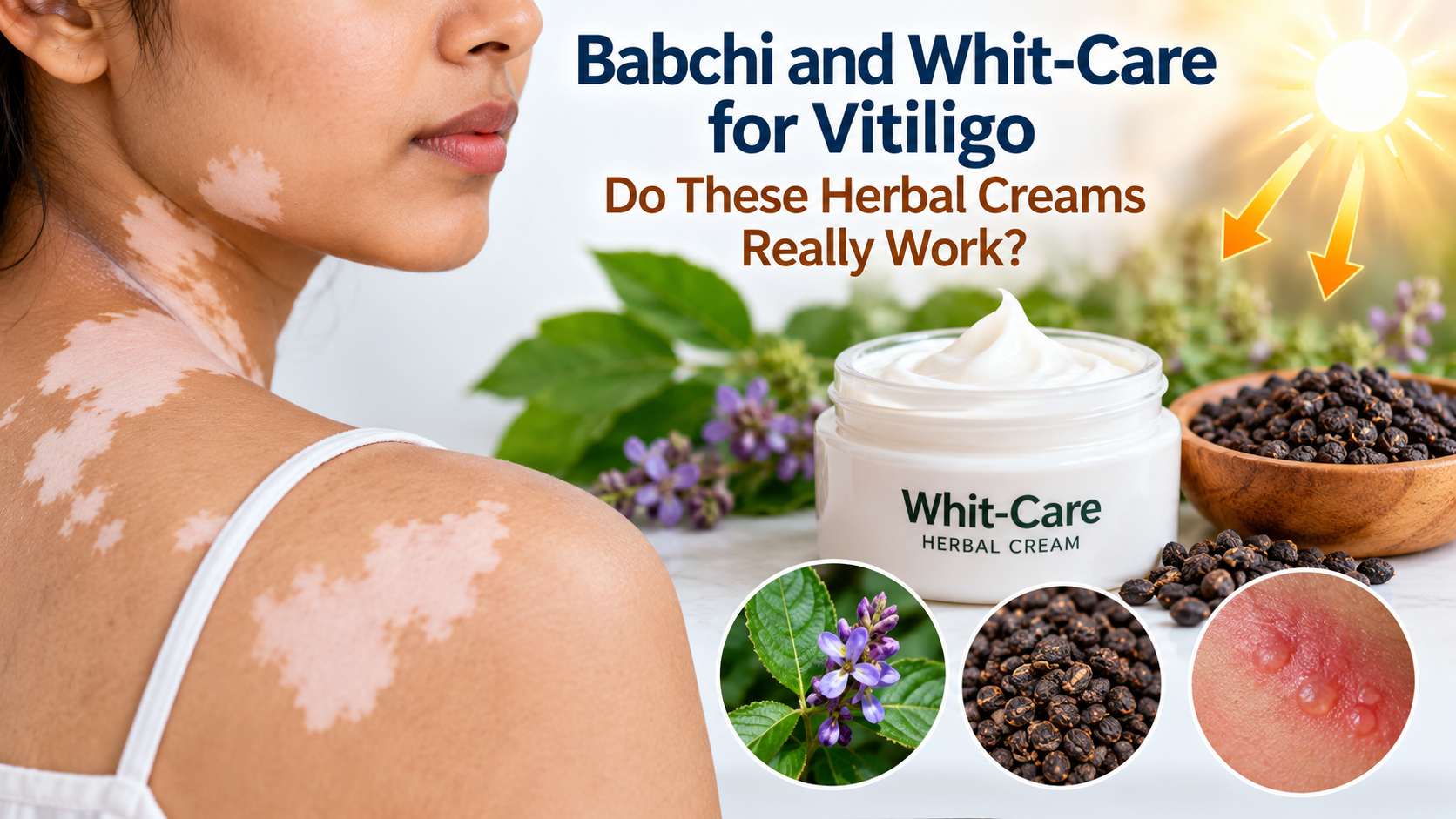
Babchi (bakuchi) is a traditional herbal treatment for vitiligo, used alone or as an ingredient in products such as Whit-Care cream. Although there is some preliminary evidence that babchi preparations may stimulate repigmentation, reliable clinical evidence for individual commercial formulations remains limited. Natural ingredients are not necessarily safer: babchi contains compounds capable of causing significant skin reactions when exposed to sunlight.
What Is Babchi And How Might It Work?
Babchi, derived from Psoralea corylifolia, contains naturally occurring furocoumarins, including psoralen and isopsoralen (angelicin).
Psoralens make the skin more sensitive to ultraviolet radiation. This property has been used medically in psoralen-based photochemotherapy, including PUVA and PUVASOL, to treat certain skin conditions, including vitiligo.
Whit-Care is a multi-ingredient herbal cream marketed in India. Published product listings describe Psoralea corylifolia as one of its ingredients, commonly specifying a concentration of 5%.
However, 5% babchi does not mean 5% psoralen.
The amount of active photosensitising compounds delivered to the skin depends on the form of the botanical ingredient, its chemical composition, extraction, formulation and stability. Consequently, two preparations containing babchi may not have the same effectiveness or phototoxicity.
Does Babchi Have Scientific Evidence For Vitiligo?
Some small clinical studies have investigated babchi preparations.
A 2016 study evaluated an ointment containing 10% Psoralea corylifolia seed powder in 20 patients with vitiligo over 12 weeks. The researchers reported statistically significant repigmentation in treated patches compared with untreated control areas.
However, the study was small, non-blinded and self-controlled. The participants also received instructions for sunlight exposure, complicating the interpretation of the treatment’s effects. Skin irritation occurred in some participants.
The researchers did not compare the preparation with established vitiligo treatments such as topical corticosteroids, tacrolimus or narrowband UVB.
Researchers have also studied other babchi-containing preparations, but their results do not automatically apply to commercially available creams.
At present, researchers have not identified convincing published evidence that Whit-Care works or offers greater safety than established vitiligo treatments. This does not establish that the cream is ineffective. It means that its benefits and risks have not been adequately quantified.
Can Babchi Cream Cause Burns Or Blistering?
Yes. Babchi contains naturally occurring photosensitisers capable of producing severe phototoxic reactions.
In 2021, a published case report described a woman who developed extensive phytophotodermatitis after applying babchi oil and exposing her skin to sunlight. She required treatment in a burns unit.
In 2024, dermatologists from AIIMS New Delhi reported severe erythema and blistering in a child with vitiligo following application of crushed Psoralea corylifolia seeds.
These incidents involved different preparations, not Whit-Care. Therefore, they cannot establish the safety profile of Whit-Care itself. However, they demonstrate why herbal photosensitisers should not be assumed to be harmless.
Commercial instructions for babchi-containing creams vary, with some recommending sunlight exposure after application and others providing no specific sunlight protocol. Patients should not improvise their own sunlight exposure schedules or combine such creams with additional UV treatment without medical supervision.
If marked redness, pain or blistering develops after using a product, discontinue it and obtain medical assessment.
How Does Babchi Compare With Established Vitiligo Treatments?
There are several treatments with better-established clinical evidence.
Topical corticosteroids are commonly used for limited vitiligo, particularly on appropriate body sites. Their use must be balanced against possible adverse effects, including skin thinning.
Topical calcineurin inhibitors, such as tacrolimus, are useful particularly for facial and other sensitive areas where prolonged potent steroid use may be undesirable.
Narrowband UVB phototherapy is an established treatment for more extensive disease, while targeted UVB may be appropriate for localised patches.
Topical psoralen photochemotherapy, including PUVASOL, is another option in selected circumstances. It uses a pharmaceutical photosensitiser of known concentration, but sunlight-based UV exposure is variable and phototoxicity remains an important limitation.
These treatments are not interchangeable. Treatment choice depends on the patient’s age, disease activity, distribution, extent, previous response and access to phototherapy.
An inadequately studied herbal formulation should not automatically replace a treatment with stronger clinical evidence simply because it is described as natural.
When Should You Seek Specialist Advice?
A dermatological assessment is particularly useful when white patches are newly appearing or spreading, when previous treatments have failed, or when a prescribed cream causes irritation.
Not every white patch is vitiligo. Other conditions can produce similar appearances and require different management.
For patients already using babchi or Whit-Care, reviewing the exact formulation, treatment duration, exposure to sunlight and any response or side effects can help clarify whether continuing treatment is reasonable.
Frequently Asked Questions
Is Whit-Care proven to repigment vitiligo?
There is limited research on babchi preparations, but insufficient product-specific clinical evidence to establish Whit-Care’s efficacy.
Is babchi safer than psoralen?
Not necessarily. Babchi itself contains naturally occurring psoralens. Safety depends on their concentration, the preparation and the amount of ultraviolet exposure.
Can children use babchi products?
Unsupervised use is inadvisable, particularly given published cases of severe phototoxicity. Better-established paediatric vitiligo treatments are available.
Should I stop my existing vitiligo treatment and switch to an herbal cream?
Not without discussing the change with your dermatologist. Switching may interrupt a treatment that is working, and the alternative may have less reliable evidence.
Need Help Reviewing Your Vitiligo Treatment?
If you are uncertain about a vitiligo treatment or have questions about a herbal preparation you are using, Online Skin Specialist offers educational dermatology advisory reviews. You can share an appropriately anonymised treatment history and relevant information for specialist commentary on the evidence and possible next steps to discuss with your treating doctor.
This is an advisory-only service, not a substitute for medical examination or a prescribing consultation.
Author: Dr. Sasi Kiran Attili, Consultant Dermatologist & Dermatopathologist.
References
1. Hussain I, et al. Fabrication of anti-vitiligo ointment containing Psoralea corylifolia: In vitro and in vivo characterization. Drug Des Devel Ther. 2016;10:3805–3816. https://doi.org/10.2147/DDDT.S114328
2. Faulkner J, et al. Babchi oil-induced phytophotodermatitis mimicking burn injury. JPRAS Open. 2021;27:23–26. https://doi.org/10.1016/j.jpra.2020.11.003
3. Mehta N, et al. Severe phototoxic reaction to Psoralea corylifolia seeds in a child with vitiligo. Contact Dermatitis. 2024;90:619–621. https://doi.org/10.1111/cod.14527
4. Seneschal J, et al. Worldwide expert recommendations for the diagnosis and management of vitiligo: Part 2. JEADV. 2023;37:2185–2195. https://doi.org/10.1111/jdv.19450