

Scalp threading for hair loss has emerged as a procedural option for androgenetic alopecia and female-pattern hair loss, usually involving absorbable polydioxanone (PDO) threads placed beneath the scalp. The proposed benefit is that insertion creates controlled tissue injury and a wound-healing response that may influence follicular activity. As a UK-trained dermatologist and dermatopathologist, Dr. Sasi Kiran Attili approaches procedures such as this by separating biological plausibility from evidence of meaningful clinical benefit. The key question is not simply whether hair parameters can improve after threading, but whether leaving a PDO thread in the scalp adds enough benefit to justify the procedure.
Understanding Scalp Threading for Hair Loss
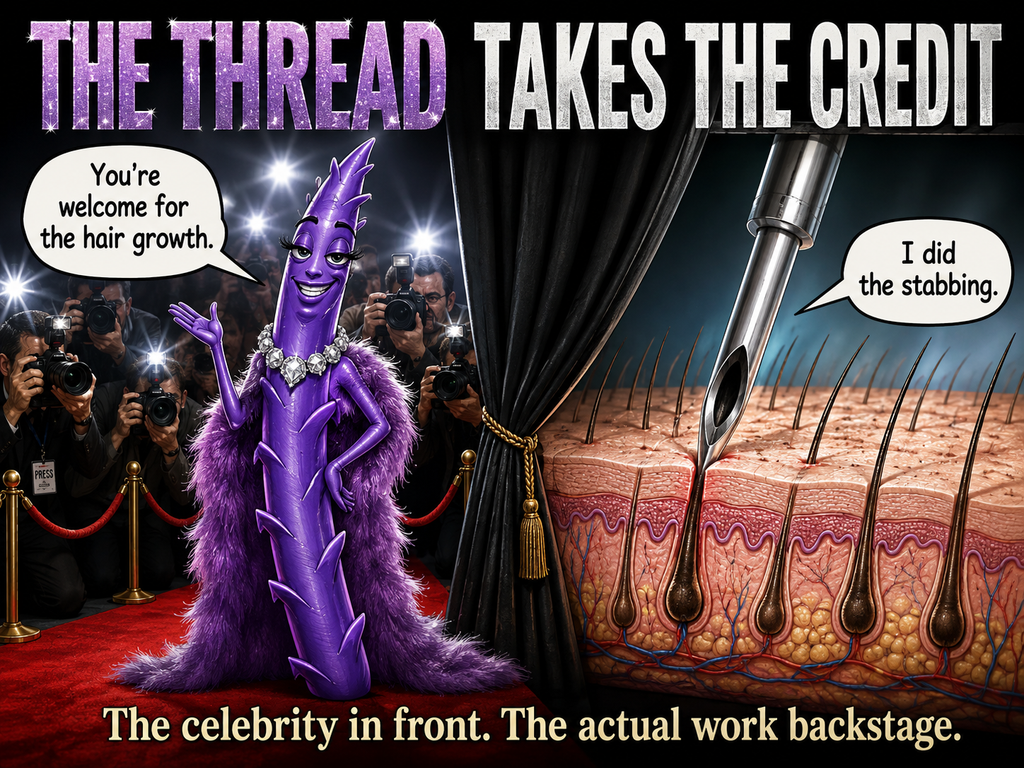
PDO threads are absorbable surgical sutures that gradually break down after they enter tissue. In hair-restoration procedures, clinicians insert monofilament or other thread designs beneath the scalp to create controlled inflammation and stimulate wound-healing pathways around hair follicles.
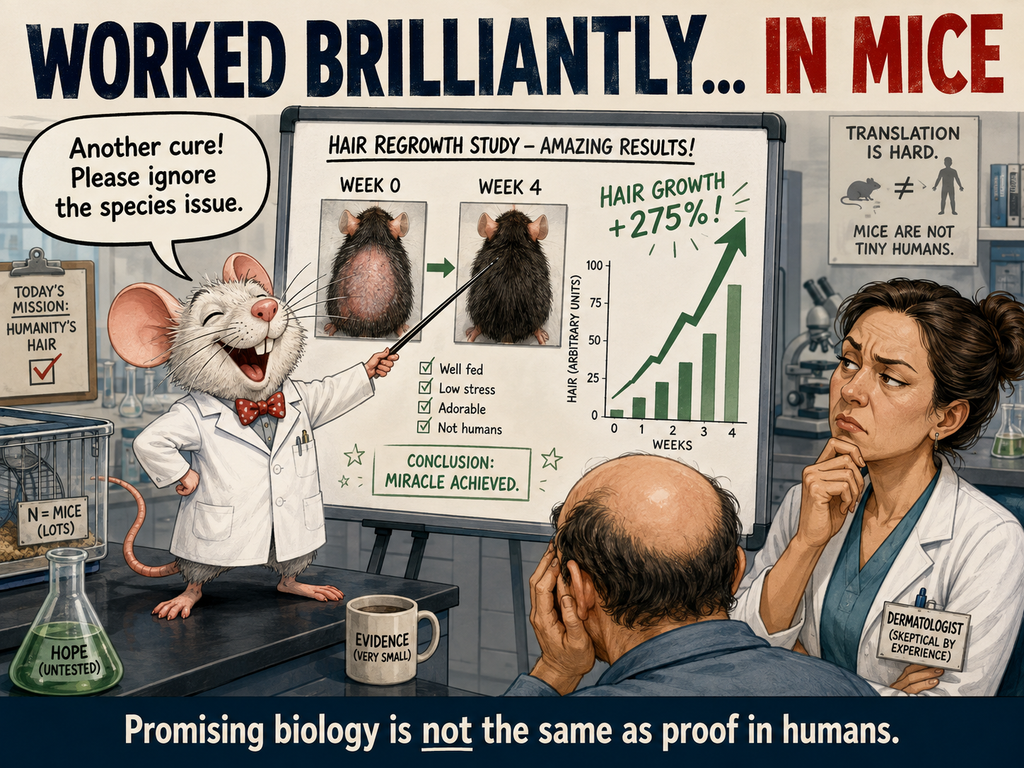
There is biological plausibility for this approach. Experimental work in mice has demonstrated changes in anagen activity and hair-growth-related biological markers after thread-embedding therapy. However, animal experiments cannot establish the clinical effectiveness of a specific human scalp-threading technique.
Human evidence remains limited. An early report involving five men with androgenetic alopecia described an increase in measured hair density after repeated PDO monofilament thread treatment. Because the study did not include a control group, it could not determine how much of the improvement resulted from the thread itself, insertion trauma, measurement variation, natural fluctuation, or another factor.
A subsequent controlled study in 30 women compared monofilament threading with intradermal saline injections. Hair count and Hair Mass Index improved in the thread-treated group at six months. This provides more meaningful evidence that the procedure can affect measured hair parameters, but it does not establish that scalp threading is superior to established or better-studied procedural options.
Why Standard Treatments Often Fail to Answer the Scalp Threading Question
Patients considering procedures for hair loss often encounter a long list of options—medication, injections, PRP, microneedling, lasers and, increasingly, scalp threads. The difficulty is that improvement following a procedure does not automatically identify which component of that procedure caused the improvement.
Thread insertion itself causes repeated mechanical injury to the scalp. Researchers know that controlled injury can trigger wound-healing pathways that influence follicular behaviour, which helps explain the interest in procedures such as microneedling for hair restoration..
This creates an important unanswered question. If hair improves after a clinician introduces a PDO thread through a needle or cannula, how much of that benefit comes from the controlled injury, and how much comes from the polymer left behind?
The available clinical studies do not yet isolate those two effects.
The Diagnostic Approach
Before choosing a procedural treatment, the first priority is establishing what type of hair loss is present and whether a procedure is appropriate for it.
A specialist assessment generally considers the pattern and duration of hair loss, the rate of progression, previous treatments, associated scalp symptoms, family history and relevant medical factors. Clinical photographs and close scalp assessment can help distinguish patterned thinning from disorders that may require a different approach.
When the diagnosis remains uncertain, particularly when inflammation, scarring or an atypical pattern is suspected, clinicians may need further investigation. Online assessment can help clinicians review the history, previous treatment response and high-quality scalp photographs, but some patients still require direct examination or additional investigations before clinicians can make a definitive treatment plan.
Evidence-Based Treatment Strategies for Scalp Threading for Hair Loss Decisions

The existing evidence suggests that scalp threading should currently be considered an inadequately established rather than proven first-line treatment for androgenetic alopecia.
The strongest question is comparative effectiveness. PRP has a substantially larger clinical evidence base than PDO threading, although PRP itself has limitations. Preparation techniques and treatment protocols vary, and studies do not show uniform benefit across every outcome measure.
A 2023 systematic review and meta-analysis of nine randomised trials involving 238 patients reported a significant improvement in hair density with PRP compared with placebo at three and six months, while effects on some other hair measurements were less consistent.
More importantly, one direct split-scalp comparison studied 30 patients with androgenetic alopecia and treated one side with PRP and the other with monofilament threads. In that study, PRP produced greater improvements in both hair density and hair diameter.
That single study is too small to settle the question permanently, but it matters because it compares threading with an active procedural treatment rather than an inert comparator.
For patients considering scalp threading, a rational treatment discussion should therefore consider:
- whether the diagnosis of androgenetic alopecia or female-pattern hair loss is secure;
- whether established medical treatment has been appropriately considered;
- whether a procedural treatment is genuinely needed;
- the relative evidence supporting PRP, threading and other procedures;
- the cost and treatment burden of repeated sessions;
- the uncertainty about whether the retained PDO material adds benefit beyond insertion injury;
- the absence of robust long-term scalp-specific safety data.
The most informative future study would compare PDO-thread insertion with identical needle or cannula passes performed without leaving a thread behind. Such a design could directly test whether the polymer provides additional therapeutic value.
What Do We Know About Safety?
Published scalp-threading studies have mainly described short-term effects such as discomfort, redness, swelling and headache. These findings are somewhat reassuring, but the available studies are small and do not establish long-term safety.
Complications including inflammatory nodules, thread extrusion, dimpling and foreign-body reactions have been described in the broader facial thread-lifting literature. That does not prove that the same risks occur at the same frequency when threads are used for hair loss.
There are also unanswered questions relevant specifically to patients undergoing repeated scalp procedures. Current evidence does not adequately establish whether repeated threading could cause clinically important fibrosis or influence tissue planes relevant to future hair-transplant surgery.
These uncertainties should be part of informed decision-making rather than treated as evidence that complications will necessarily occur.
Who Should Seek a Second Opinion or Online Consultation?
A second opinion can be particularly useful when the diagnosis is uncertain or when several procedures are being presented as interchangeable despite very different evidence bases.
Patients who may benefit include those who:
- have tried multiple treatments without satisfactory improvement;
- are considering PDO scalp threading and want an independent assessment of the evidence;
- have been offered several procedural treatments without a clear explanation of why one is preferable;
- have progressive or treatment-resistant androgenetic alopecia;
- are concerned that their hair loss may not represent straightforward pattern hair loss;
- have been told that nothing further can be done;
- live outside India and want specialist input before committing to a procedure locally;
- are confused by conflicting claims about PRP, scalp threads, microneedling or other regenerative treatments.
A useful second opinion should not simply substitute one treatment recommendation for another. It should clarify the diagnosis, determine the objective of treatment and explain how strongly the available evidence supports each option.
Frequently Asked Questions
Does scalp threading for hair loss work?
Small human studies suggest that PDO scalp threading can improve certain measured hair parameters. The evidence base remains limited, however, and does not yet establish scalp threading as a standard treatment for androgenetic alopecia.
Is PRP better than PDO scalp threading?
The available evidence for PRP is broader than that for scalp threading. In the direct split-scalp comparative study cited in the source evidence, PRP produced greater improvements in hair density and hair diameter than monofilament threads, although larger comparative trials are still needed.
Could the needle injury be responsible for some of the improvement?
Possibly. Controlled scalp injury can activate wound-healing pathways associated with hair growth, so insertion trauma is a plausible contributor to the effect observed after threading. Current trials have not adequately separated the biological effect of the injury from any additional benefit produced by leaving PDO in the tissue.
Is scalp threading an established treatment for androgenetic alopecia?
Not at present. The available research is scientifically interesting and provides a rationale for larger trials, but it is much smaller than the evidence base supporting several more established approaches.
Can hair loss be treated through an online consultation?
Many hair-loss cases can be assessed initially through a structured online consultation using the clinical history, treatment history and suitable photographs. Some patients will still require an in-person scalp examination, investigations or biopsy if the diagnosis is uncertain or a scarring or inflammatory disorder is suspected.
What does a dermatopathologist look for that a regular dermatologist might miss?
Dermatopathology becomes particularly relevant when the clinical appearance alone does not adequately explain the hair loss. When biopsy is genuinely indicated, microscopic assessment can help distinguish patterns of inflammation, follicular damage and scarring that may change the diagnosis and treatment strategy; biopsy is not required for every patient with patterned hair loss.
Are PDO threads safe if I may want a hair transplant later?
There is currently insufficient long-term evidence to state confidently whether repeated scalp threading has any meaningful effect on later hair-transplant tissue planes. Patients who may consider transplantation in the future should discuss their previous scalp procedures with the clinician planning their treatment.
References
- Shin HJ, Lee DJ, Kwon K, et al. The success of thread-embedding therapy in generating hair re-growth in mice points to its possibly having a similar effect in humans. J Pharmacopuncture. 2015;18(4):20–25. doi:10.3831/KPI.2015.18.033.
- Bharti J, Sonthalia S, Patil P, Dhurat R. Scalp threading with polydioxanone monofilament threads: a novel, effective and safe modality for hair restoration. J Eur Acad Dermatol Venereol. 2017;31(11):e492–e493. doi:10.1111/jdv.14336.
- Metwalli M, Khattab FM, Mandour S. Monofilament threads in treatment of female hair loss. J Dermatolog Treat. 2021;32(5):521–525. doi:10.1080/09546634.2019.1682499.
- Zhang XX, Ji YX, Zhou MC, et al. Platelet-rich plasma for androgenetic alopecia: a systematic review and meta-analysis of randomized controlled trials. J Cutan Med Surg. 2023;27(5):504–508. doi:10.1177/12034754231191461.
- Hassan MS, El-Taweel AEI, Gohary YM. Comparison between monofilament threads and platelet rich plasma in treatment of androgenetic alopecia. Egypt J Med Res. 2025;6(3):142–156. doi:10.21608/ejmr.2025.328433.1716.
- Vathananai W, Jimenez F. What do we know about hair growth induced by wounding and its therapeutic applications? Dermatol Surg. 2023;49(11):995–1000. doi:10.1097/DSS.0000000000003901.
- Niu Z, Zhang K, Yao W, et al. A meta-analysis and systematic review of the incidences of complications following facial thread-lifting. Aesthetic Plast Surg. 2021;45(5):2148–2158. doi:10.1007/s00266-021-02256-w.
If you have a complex hair-loss case, have tried treatments without success, or need a specialist second opinion about scalp threading or other procedural treatments, Dr. Attili offers structured online consultations. [Book Online Consultation]